Design Consistent Hashing
4 min read- What it is: distribute requests/data across servers so adding/removing a server moves only ~k/n keys (vs nearly all)
- How: servers + keys on a hash ring (SHA-1); key stored on first server clockwise
- Two fixes: virtual nodes → balanced partitions + even key distribution
- Used by: DynamoDB, Cassandra, Discord, Akamai CDN, Maglev load balancer
Consistent hashing distributes requests/data efficiently across servers for horizontal scaling, minimizing redistribution when servers are added/removed.
1 of 5: The rehashing problem
Traditional approach: serverIndex = hash(key) % N where N = server count.
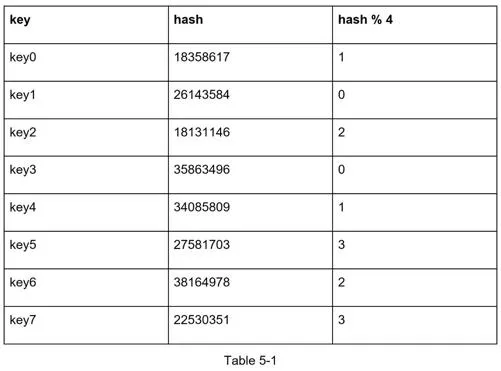
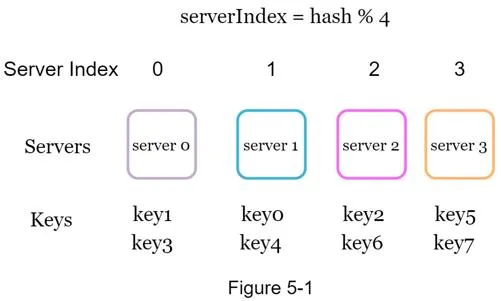
When N changes (server added/removed), most keys get different server indexes: not just the keys from the affected server. This causes a storm of cache misses.
Example: Server 1 goes offline (N=4 → N=3).
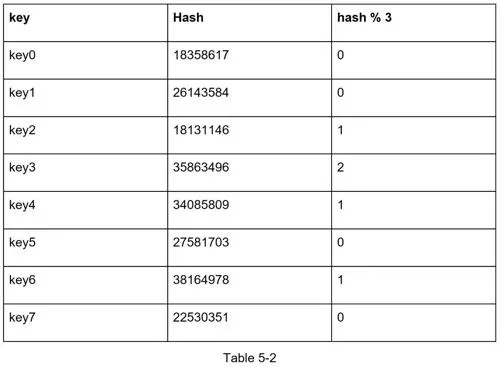
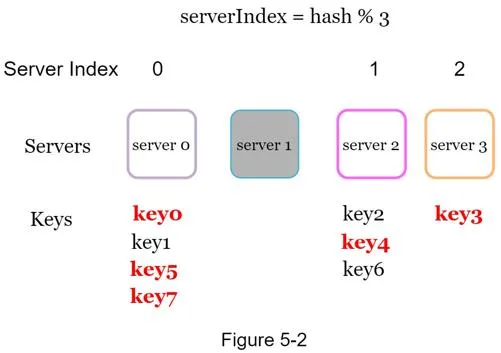
Most keys are redistributed to different servers even if they weren't stored on server 1.
2 of 5: Consistent hashing basics
Only k/n keys need remapping on average (k = keys, n = slots), vs nearly all keys with traditional hashing.
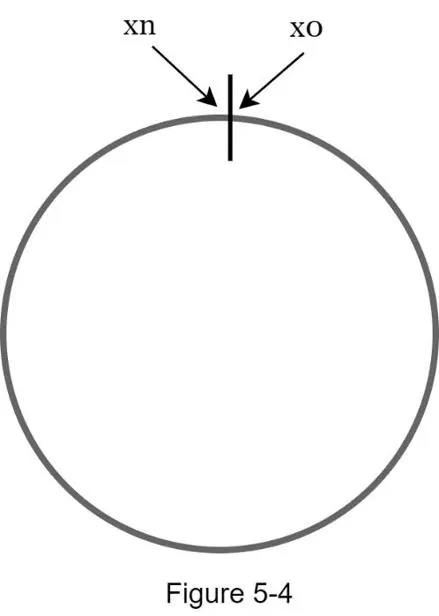
Hash space and hash ring
Using SHA-1 (hash space 0 to 2^160 − 1):

Connect both ends → hash ring:
Hash servers and keys
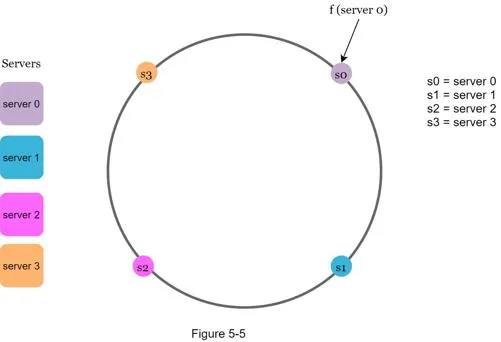
Map servers onto the ring by hashing IP or name:
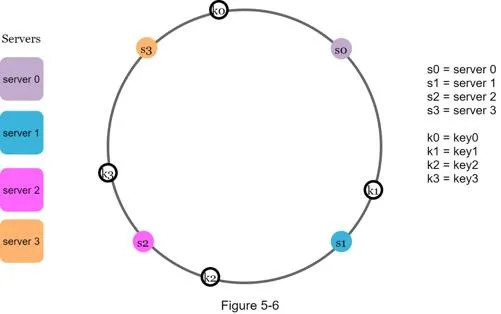
Hash cache keys onto the same ring (no modular operation):
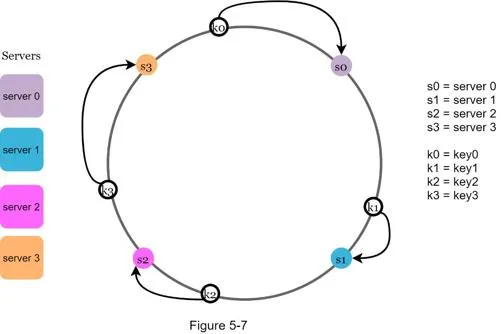
Server lookup
To find which server stores a key: go clockwise from the key's position until a server is found.
3 of 5: Add and remove servers
Add a server: only keys between the new server and its predecessor (anticlockwise) need redistribution.
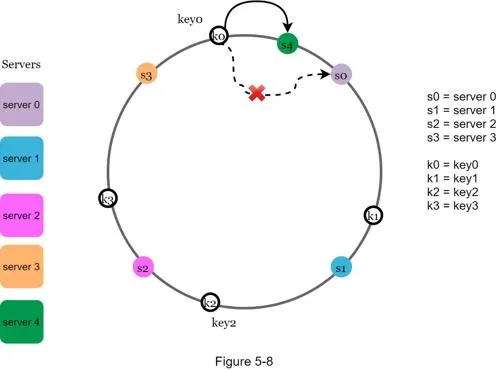
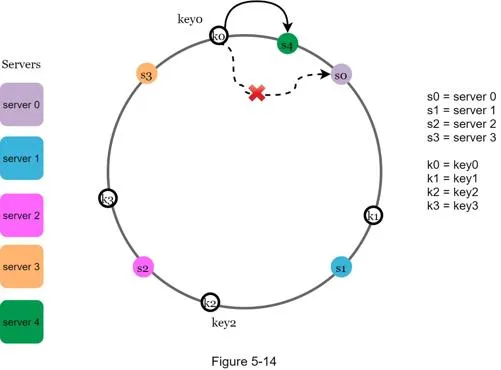
After adding server 4: only key0 redistributed (moves from server 0 to server 4). k1, k2, k3 stay.
Remove a server:
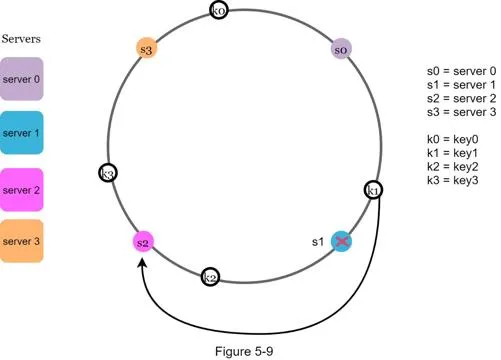
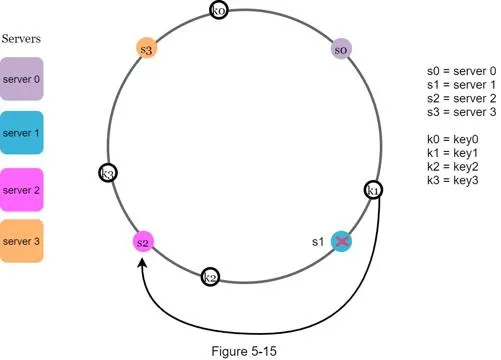
When server 1 removed: only key1 remapped (to server 2). Others unaffected.
4 of 5. Two issues and the fix: virtual nodes
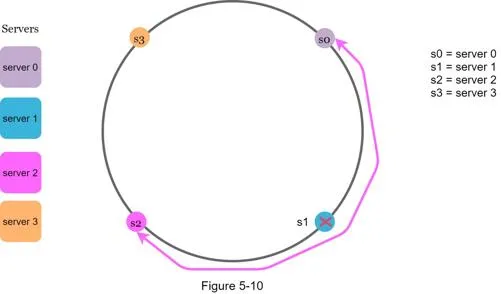
Issue 1: uneven partition sizes: partitions between adjacent servers can vary greatly. If s1 removed, s2's partition becomes twice the size of s0 and s3.
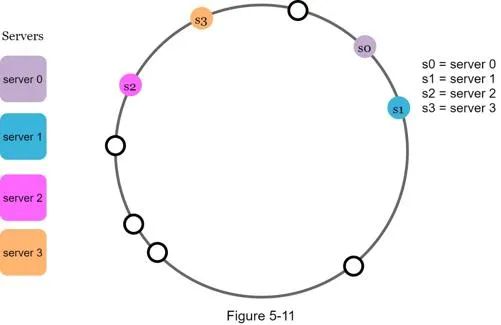
Issue 2: non-uniform key distribution: keys may cluster on specific servers, leaving others empty.
Virtual nodes
Each physical server is represented by multiple virtual nodes on the ring.
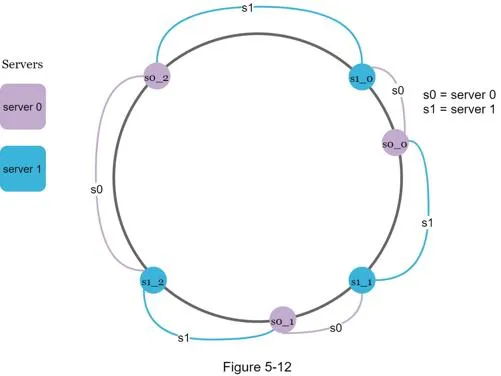
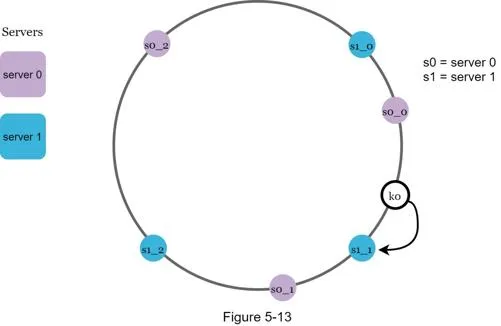
- Server 0 → s0_0, s0_1, s0_2; Server 1 → s1_0, s1_1, s1_2
- Each server responsible for multiple partitions
- Lookup: go clockwise from key to first virtual node → maps to physical server
Tradeoff: more virtual nodes = more balanced distribution, smaller standard deviation: but more memory to store virtual node data.
- 100–200 virtual nodes → standard deviation 5–10% of mean
- More virtual nodes → smaller standard deviation
5 of 5: Find affected keys and wrap up
Adding server 4: affected range starts from s4, goes anticlockwise to next server (s3). Keys between s3 and s4 redistributed to s4.
Removing server 1: affected range starts from s1, goes anticlockwise to next server (s0). Keys between s0 and s1 redistributed to s2.
Benefits
- Minimized keys redistributed when servers added/removed
- Easy horizontal scaling with even data distribution
- Mitigates hotspot key problem (e.g. celebrity shard overload)
Real-world usage
- Partitioning in Amazon's Dynamo database
- Data partitioning in Apache Cassandra
- Discord chat application
- Akamai CDN
- Maglev network load balancer
[1] Consistent hashing: https://en.wikipedia.org/wiki/Consistent_hashing [2] Consistent Hashing: https://tom-e-white.com/2007/11/consistent-hashing.html [3] Dynamo: Amazon's Highly Available Key-value Store: https://www.allthingsdistributed.com/files/amazon-dynamo-sosp2007.pdf [4] Cassandra - A Decentralized Structured Storage System: http://www.cs.cornell.edu/Projects/ladis2009/papers/Lakshman-ladis2009.PDF [5] How Discord Scaled Elixir to 5,000,000 Concurrent Users: https://blog.discord.com/scaling-elixir-f9b8e1e7c29b [6] CS168: The Modern Algorithmic Toolbox Lecture #1: Introduction and Consistent Hashing: http://theory.stanford.edu/~tim/s16/l/l1.pdf [7] Maglev: A Fast and Reliable Software Network Load Balancer: https://static.googleusercontent.com/media/research.google.com/en//pubs/archive/44824.pdf