Nearby Friends
7 min read- What it is: opt-in mobile users see nearby friends: dynamic locations (vs static businesses in Proximity Service)
- Scale: 100M DAU, ~334K location updates/sec, ~13M forwarded updates/sec
- Architecture: WebSocket (real-time) + Redis location cache (TTL = active marker) + Redis pub/sub (routing: user's channel, friends subscribe)
- Bottleneck is CPU, not memory: ~130 pub/sub servers (200 GB memory needs only ~2); shard channels via consistent hashing + service discovery
- Rules: distance check at subscriber's handler, >10 min inactive → gone; whale users spread by hashing; Erlang is the alternative routing layer
Design a "Nearby Friends" feature: opt-in mobile users see geographically nearby friends. Unlike the Proximity Service (static business locations), friend locations change frequently: dynamic data.
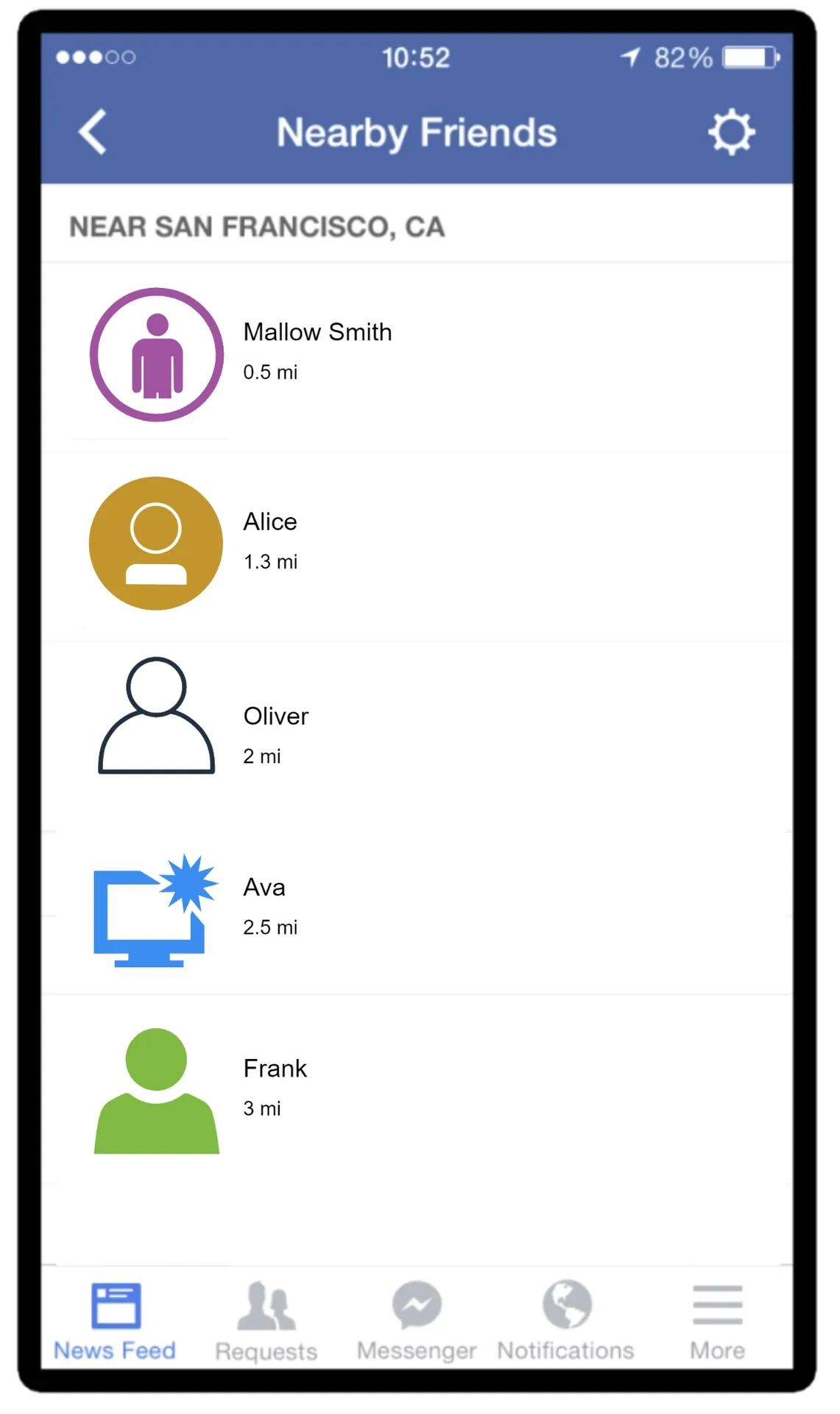
Figure 1: Facebook's nearby friends
Step 1 of 4: Understand the problem and establish design scope
Goal: lock in requirements and the load numbers.
Functional requirements
Must have:
- Users see nearby friends with distance and last-updated timestamp
- "Nearby" = within 5 miles (configurable). Straight-line distance
- Friend lists update every few seconds
- Inactive friends (no update >10 min) disappear from the list
- Store location history (for ML purposes)
- Privacy laws (GDPR/CCPA) out of scope for now
Non-functional:
- Low latency for location updates
- Reliable overall, but occasional data point loss acceptable
- Eventual consistency: a few seconds delay between replicas is fine
Back-of-the-envelope estimation:
- 1B total users; 10% use nearby friends → 100M DAU
- Concurrent users: 10% of DAU → 10M
- Users report locations every 30 seconds (walking speed ~3-4 mph, 30s movement negligible)
- Average user has 400 friends (all using the feature)
- Display 20 nearby friends per page
- Location update QPS = 10M / 30 = ~334,000
- If ~10% of friends are online and nearby: each update forwarded to ~40 friends
- Total forwarded updates: 334K × 40 = ~13M/sec
Step 2 of 4: Propose high-level design and get buy-in
Goal: reject P2P, agree on the shared backend + pub/sub routing.
High-level design
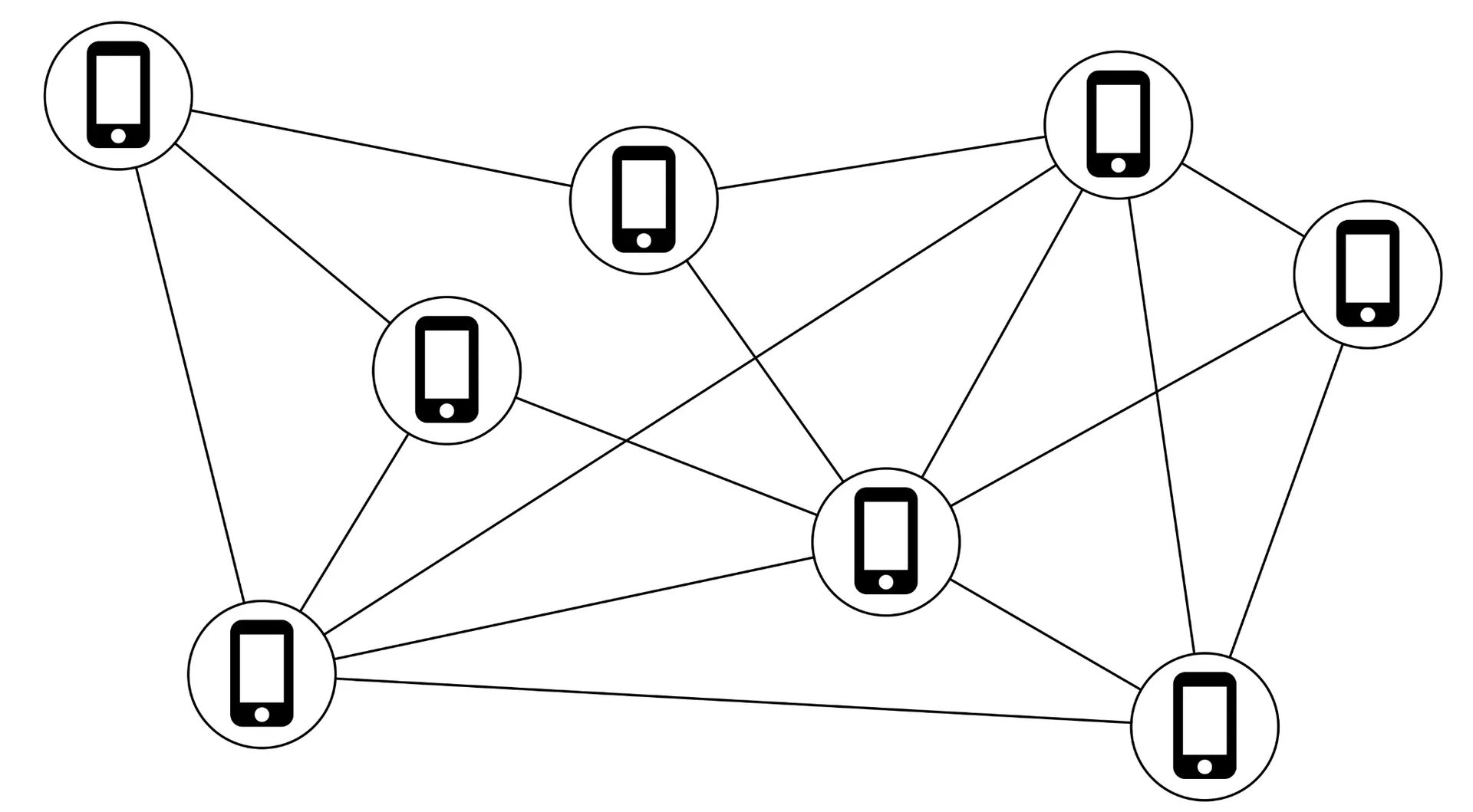
P2P approach (persistent connections to every friend) is impractical for mobile (flaky connections, power constraints). Shared backend approach:
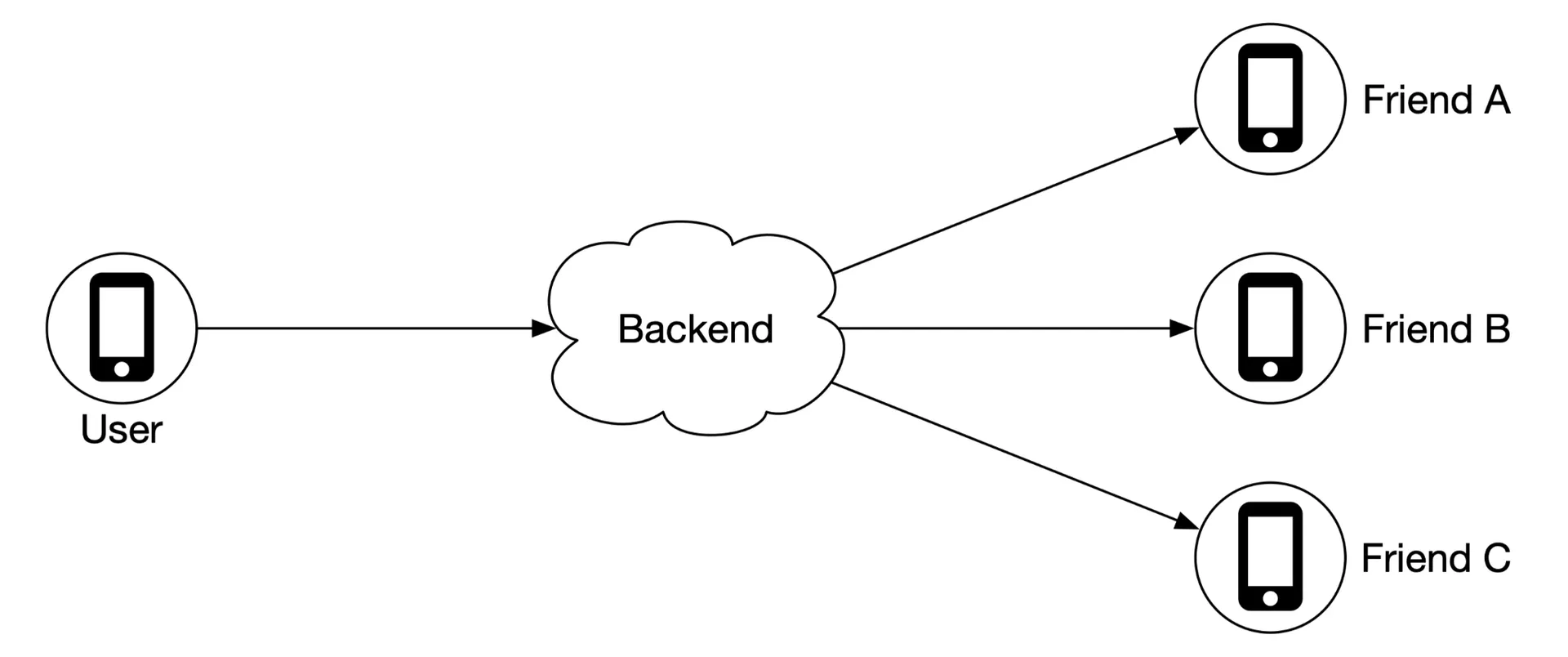
Backend responsibilities:
- Receive location updates from all active users
- Find active friends who should receive each update
- Forward only if distance ≤ threshold
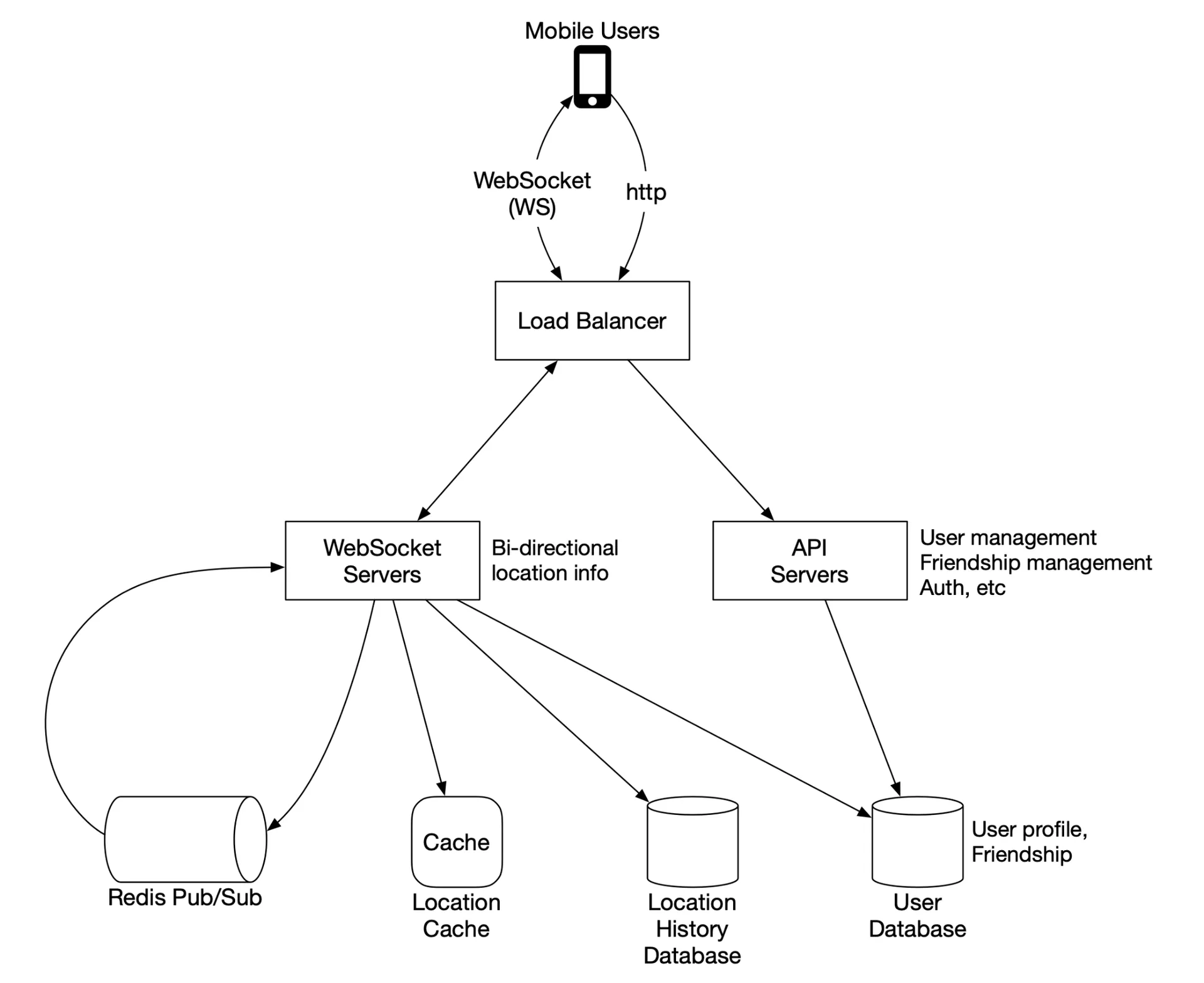
Figure 4: High-level design
Components:
- Load balancer: fronts REST API + WebSocket servers. Distributes traffic
- RESTful API servers: stateless HTTP. Handles friends management, user profiles, etc.
- WebSocket servers: stateful. Each client maintains one persistent connection. Handles real-time location updates and client initialization (seeds the initial nearby friends list)
- Redis location cache: latest location per active user. TTL on each entry; update refreshes TTL. Expired = user inactive
- User database: user profiles + friendship data. Relational or NoSQL
- Location history database: historical locations. Cassandra (write-heavy, horizontally scalable) or sharded relational DB by
user_id - Redis pub/sub server: lightweight message bus. Each user has a channel; online friends subscribe. Location updates published to the user's channel → broadcast to all subscribers → each subscriber's WebSocket handler recomputes distance → forwards if within radius
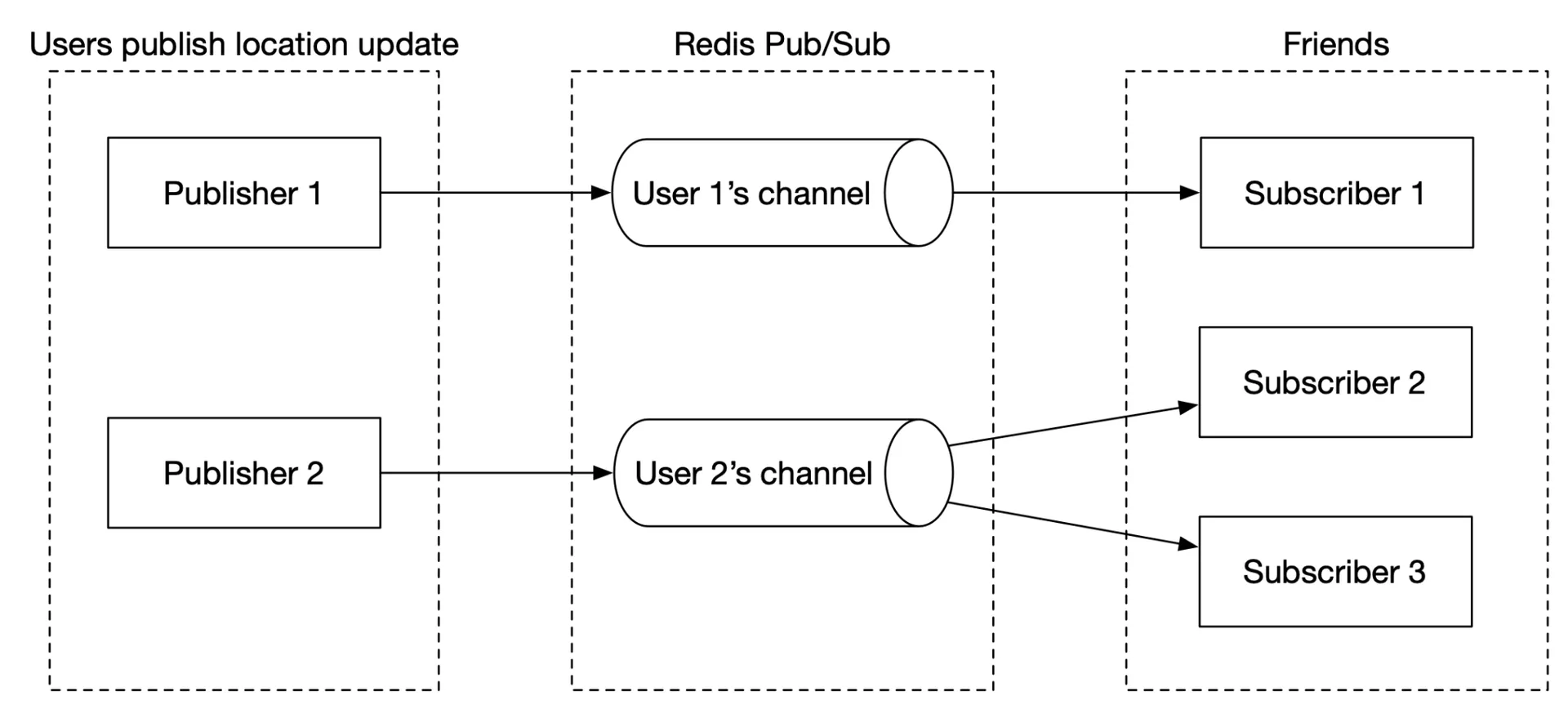
Figure 6: Redis Pub/Sub
Periodic location update flow
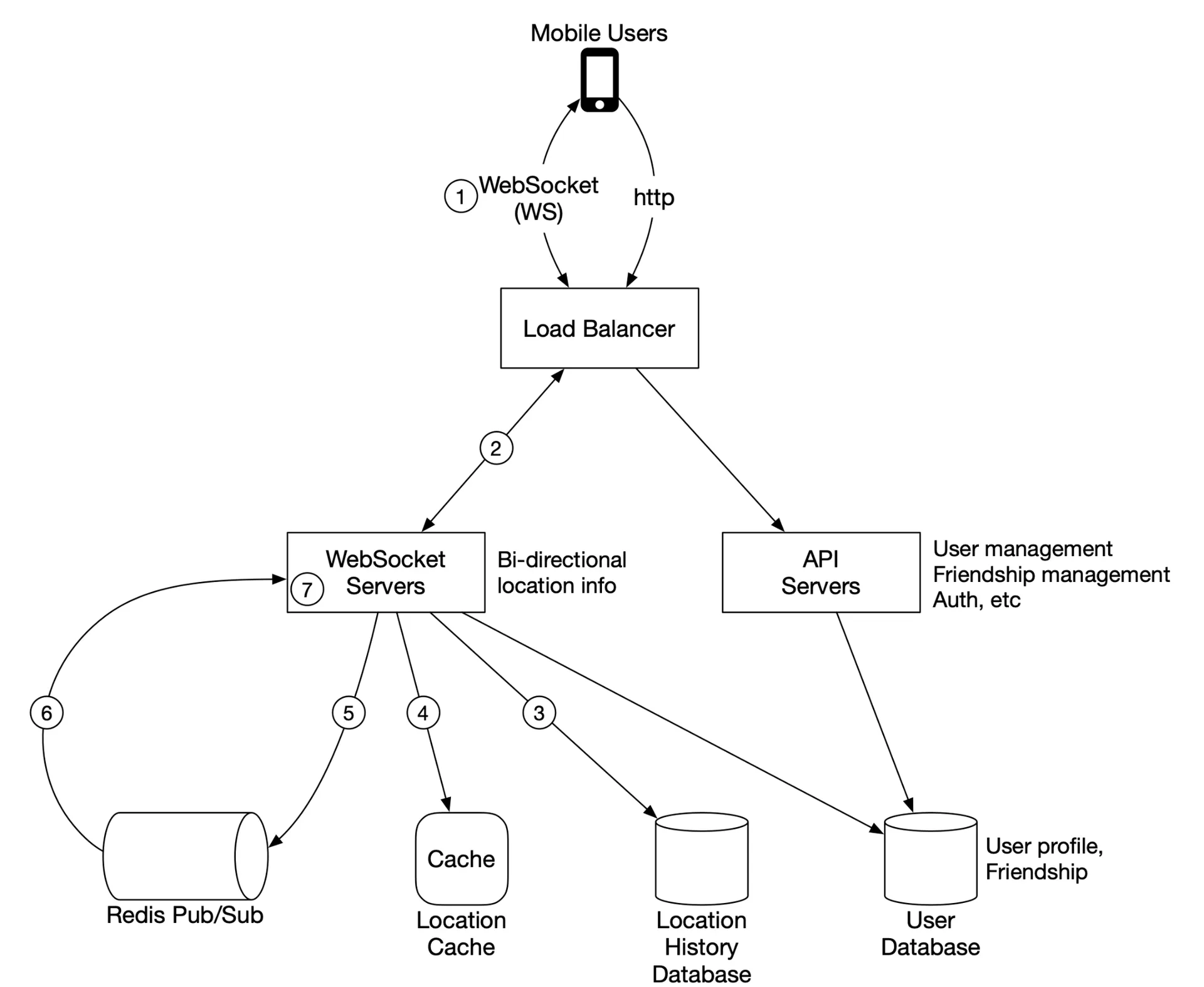
Figure 7: Periodic location update
- Mobile client sends location update via persistent WebSocket connection
- Load balancer forwards to the WebSocket server for that client
- WebSocket server saves to the location history database
- WebSocket server updates the location cache (refreshes TTL) and stores in the connection handler variable
- WebSocket server publishes to the user's Redis pub/sub channel (steps 3–5 in parallel)
- Redis pub/sub broadcasts to all subscribers (online friends' WebSocket handlers)
- Each subscriber's WebSocket handler computes the distance between the updating user and the subscriber
- If distance ≤ search radius → forward to subscriber's client. Otherwise drop
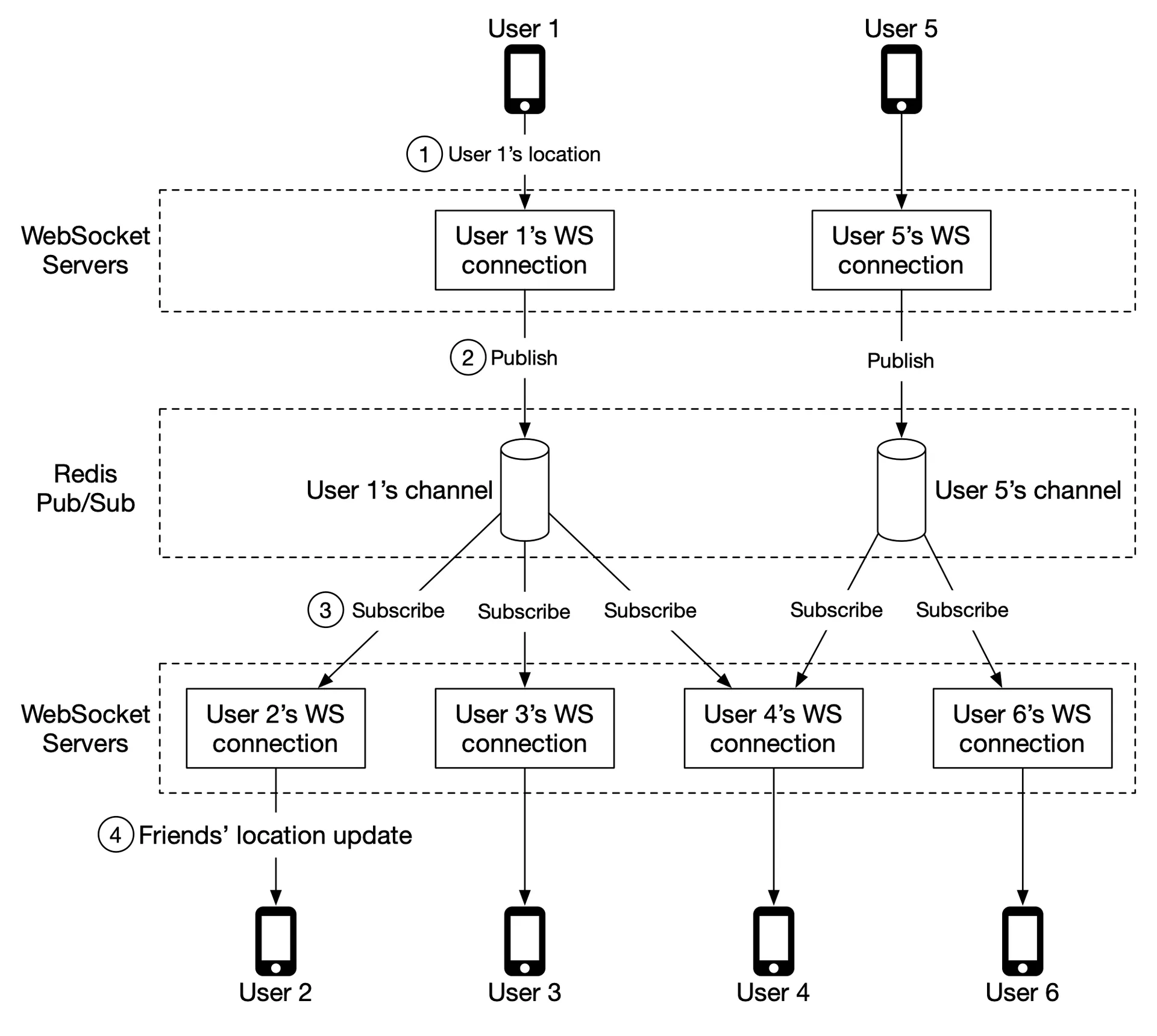
Figure 8. Example: User 1's friends = {2,3,4}. Update published to User 1's channel → broadcast to handlers for users 2,3,4 → distance check → forward.
API design
WebSocket APIs:
- Periodic location update: client sends (lat, lng, timestamp). No response
- Client receives location updates: friend's (lat, lng, timestamp)
- WebSocket initialization: client sends (lat, lng, timestamp); receives all nearby friends' locations
- Subscribe to new friend: server sends friend ID; receives friend's (lat, lng, timestamp)
- Unsubscribe friend: server sends friend ID. No response
HTTP: friends CRUD, user profiles: standard.
Data model
Redis location cache:
| Key | Value |
|---|---|
| user_id | {latitude, longitude, timestamp} |
Why Redis? Only need the current location (one per user); TTL auto-purges inactive users; no durability needed (cache can be rebuilt from new updates). Super-fast reads/writes.
Location history database (Cassandra):
| user_id | latitude | longitude | timestamp |
|---|
Handles heavy-write workload; horizontally scalable. Alternative: relational DB sharded by user_id.
Step 3 of 4: Design deep dive
Goal: scale each component: especially the pub/sub routing layer.
Scaling each component
API servers: stateless → standard auto-scaling by CPU/load/I/O.
WebSocket servers: stateful but auto-scalable. Before removing a node, mark it "draining": no new connections; wait for existing connections to close.
Client initialization (on WebSocket connect):
- Update the user's location in cache
- Save location in the connection handler variable
- Load all friends from the user DB
- Batch-fetch friends' locations from the location cache (TTL = inactivity timeout, so inactive friends won't be in cache)
- For each located friend, compute distance; if within radius, return profile + location + timestamp
- Subscribe to each friend's Redis pub/sub channel (all friends, active or inactive: inactive channels consume tiny memory, zero CPU)
- Send the user's location to their own pub/sub channel
User database: shard by user_id for horizontal scaling. At scale, likely managed by a dedicated team via internal API.
Location cache (Redis):
- 10M active users peak × ~100 bytes/location → fits a single Redis server with GBs of memory
- But 334K writes/sec is likely too high for one server → shard by user_id across multiple Redis instances
- Each shard replicated to a standby for HA (promote on primary failure)
Redis pub/sub scaling
Each of 100M users gets a channel. Subscribers ≈ active friends using the feature (avg 100).
Memory: 100M channels × 100 subscribers × 20 bytes ≈ 200 GB → ~2 Redis servers (modern 100GB servers).
CPU: 13M subscriber pushes/sec. Conservative estimate: ~100K pushes/sec/server → ~130 Redis pub/sub servers needed. CPU is the bottleneck, not memory.
Distributed Redis pub/sub cluster
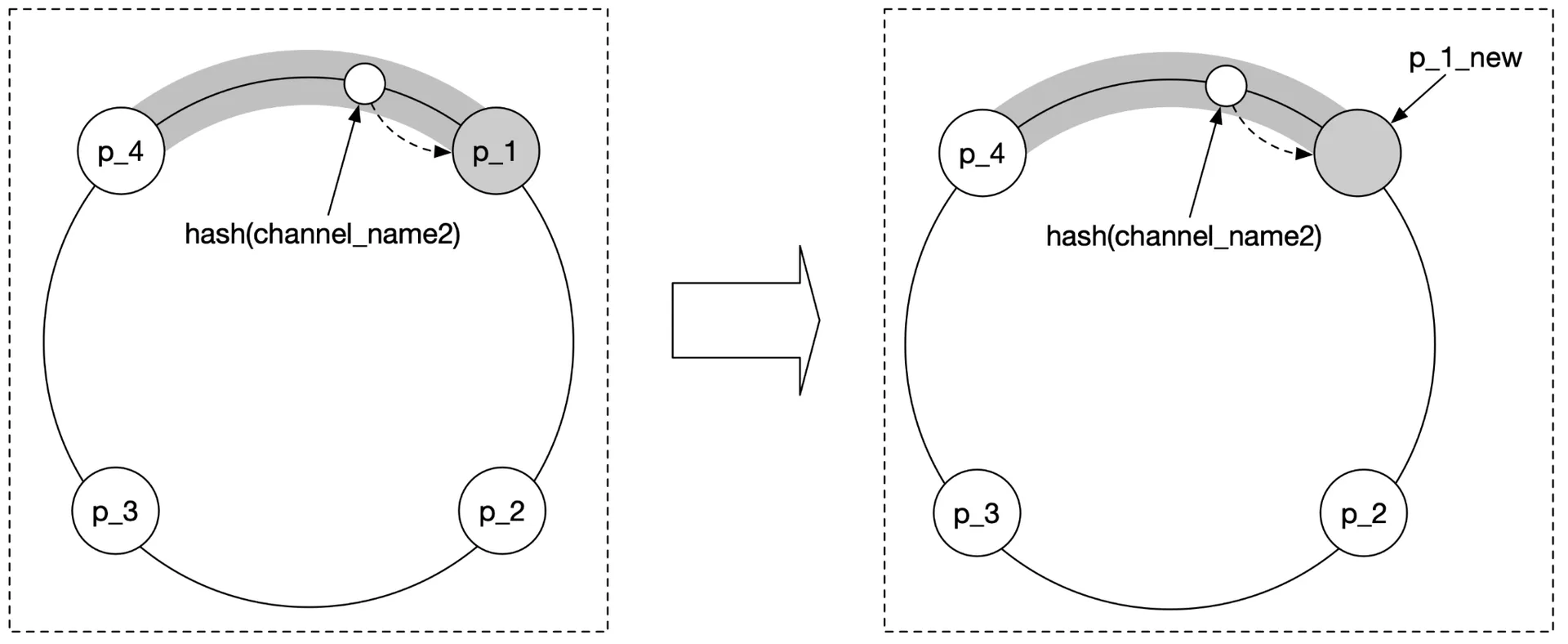
Shard channels across servers via consistent hashing on the publisher's user_id. Use service discovery (etcd/ZooKeeper) storing a hash ring:
Key: /config/pub_sub_ring
Value: ["p_1", "p_2", "p_3", "p_4"]
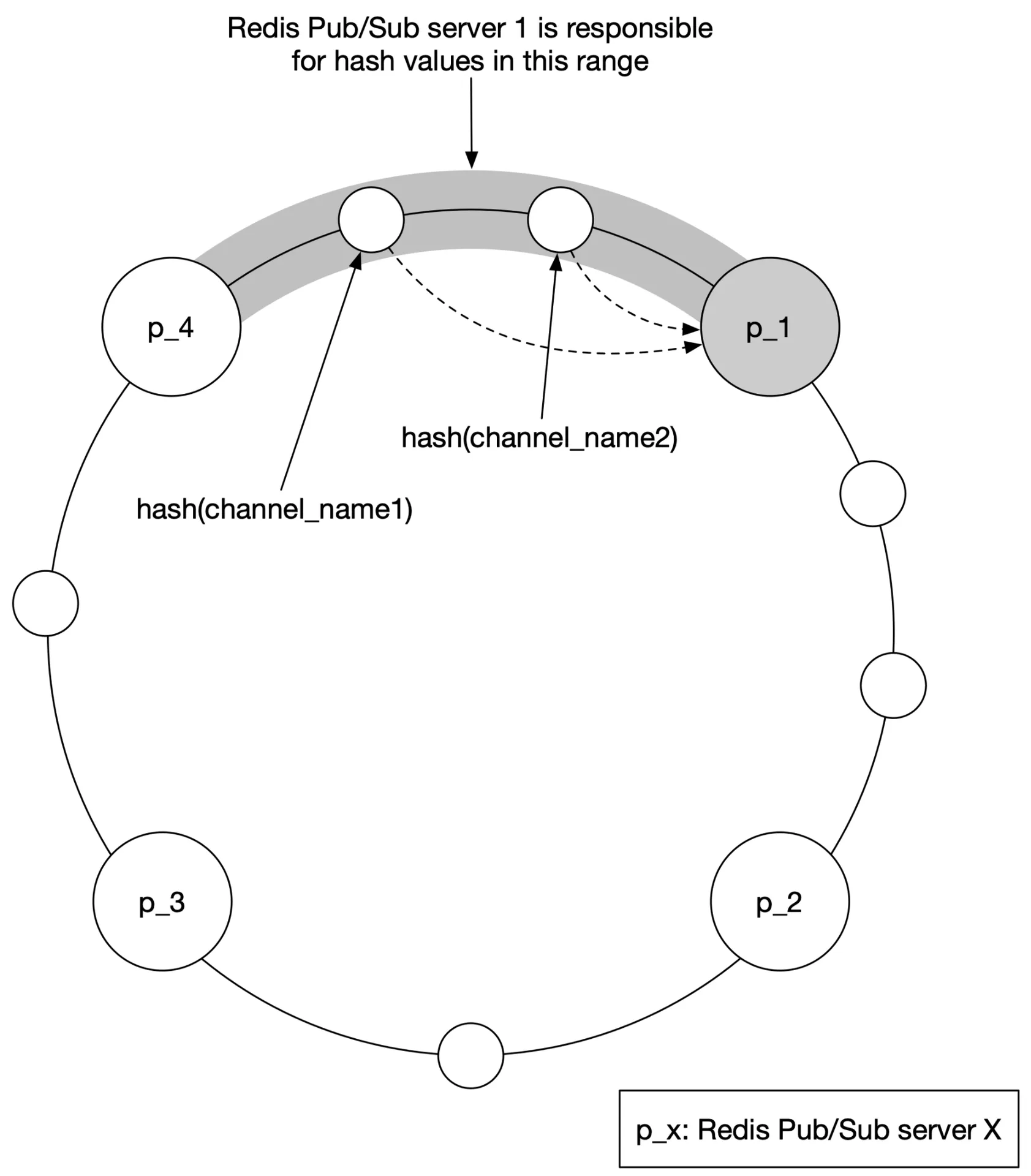
Figure 9: Consistent hashing
Publishing flow:
- WebSocket server consults the hash ring → determines the target Redis pub/sub server
- Publishes to that server
Subscribing: same mechanism.
Scaling considerations:
- Messages are stateless (not persisted; dropped if no subscribers). But subscriber lists ARE stateful
- Moving channels (resizing the cluster) → mass resubscription events → potential missed updates. Resize during low-traffic hours. Over-provision for headroom
- Replacing a single failed server causes fewer channel moves than resizing
Node replacement:
- On-call updates the hash ring to replace the dead node with a standby
- WebSocket servers notified → each handler checks subscribed channels → re-subscribes if the channel moved
Adding/removing friends
Register callbacks in the mobile app. On friend add → WebSocket subscribes to the new friend's channel + returns the friend's latest location. On friend remove → unsubscribe. Same for opt-in/opt-out changes.
Users with many friends
Hard cap on friends (e.g. Facebook's 5,000). Subscribers scattered across the WebSocket cluster → no hotspots. "Whale" users spread across pub/sub servers.
Nearby random person (extra credit)
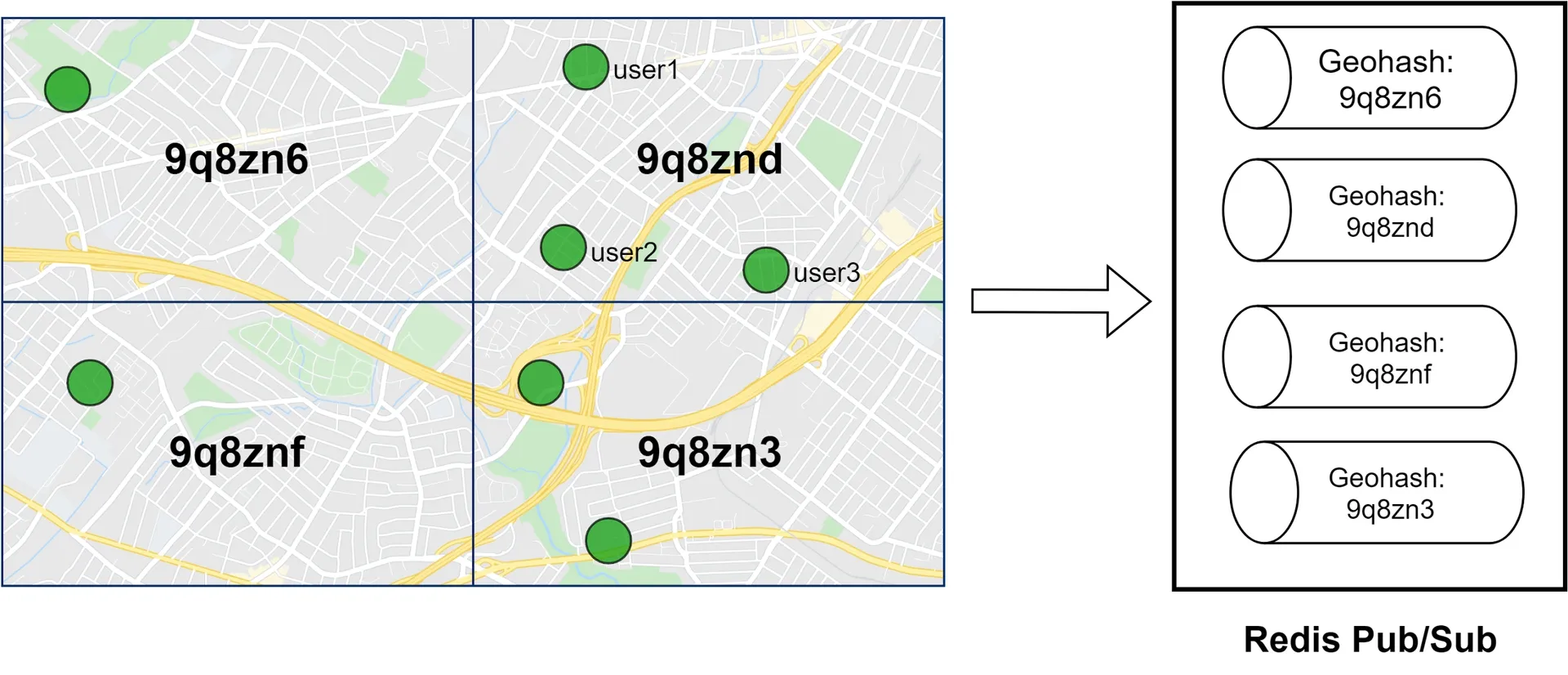
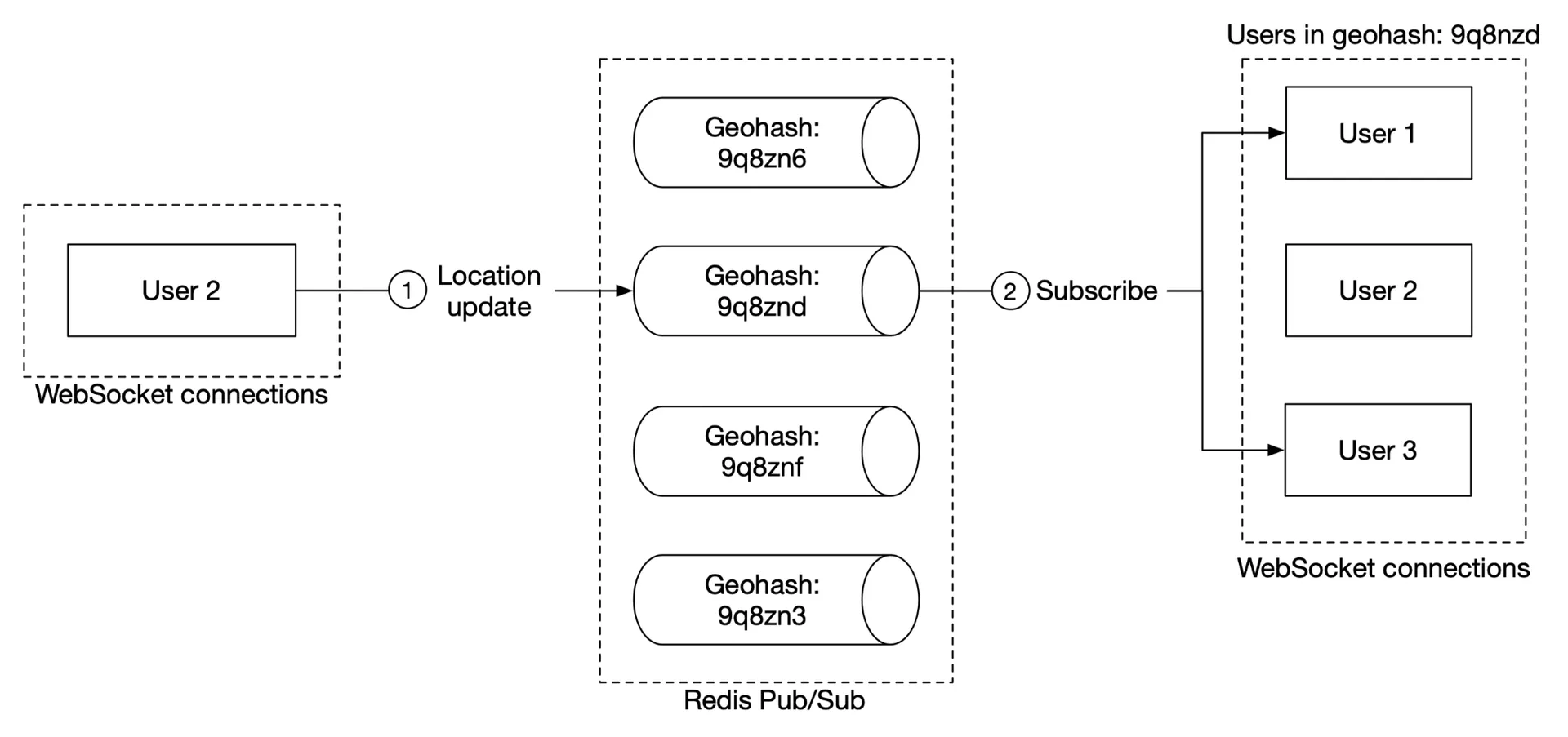
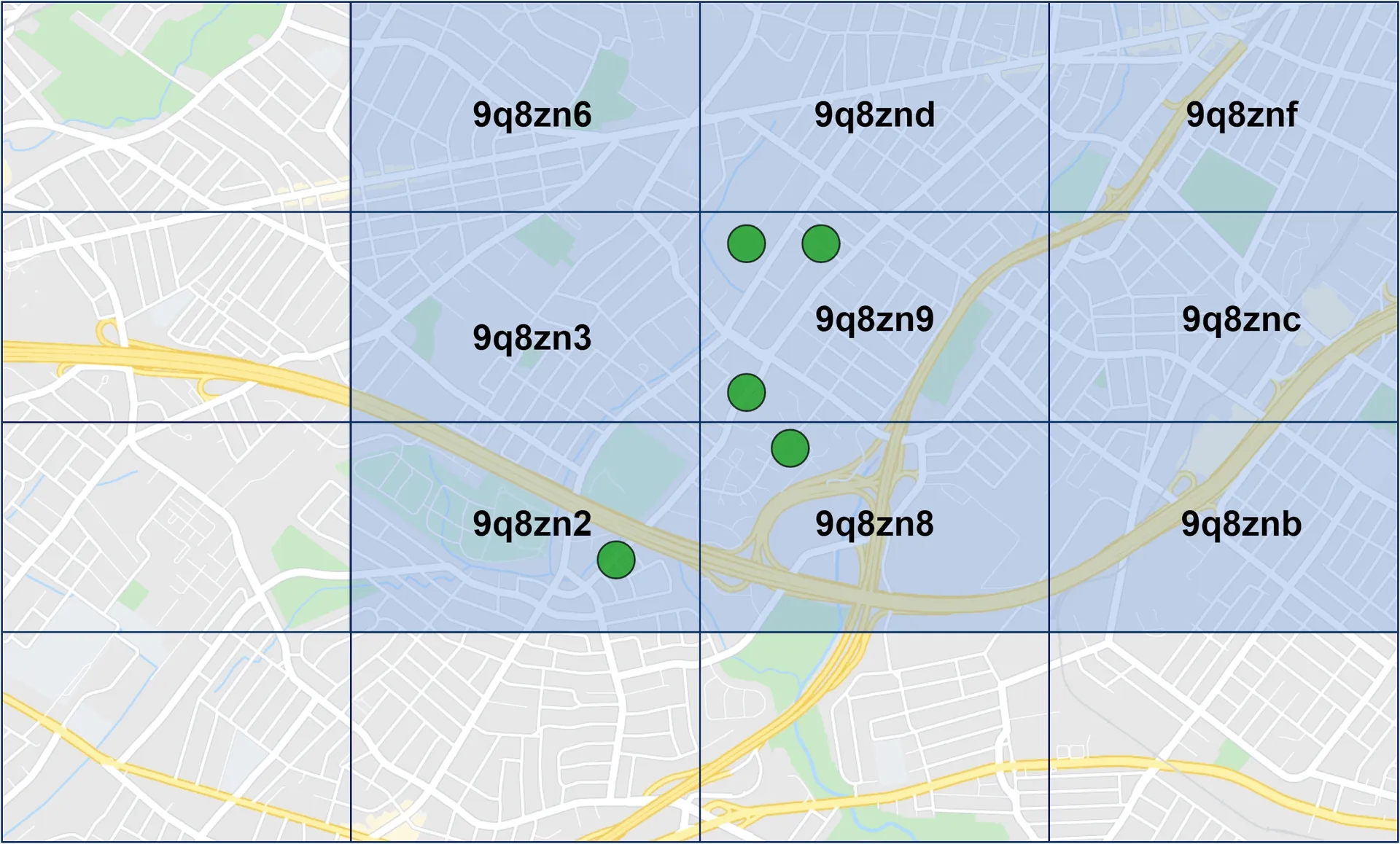
Add pub/sub channels by geohash. Users in the same geohash subscribe to the same channel. To handle border cases, subscribe to your own geohash + 8 surrounding grids (9 total).
Alternative: Erlang
Erlang/Elixir on the BEAM VM: lightweight processes (~300 bytes each, millions per server). Model each active user as an Erlang process with native pub/sub. Eliminates the Redis pub/sub cluster entirely. Operational tools are excellent. Downside: niche skill, hard to hire.
Step 4 of 4: Wrap up
What we designed:
- WebSocket (real-time comm), Redis (fast location read/write), Redis pub/sub (routing layer)
- Scaling: consistent hashing for pub/sub, sharding for location cache and user DB
- Addressed friend add/remove, whale users, and the nearby-random-person extension
- Erlang as an alternative routing layer