Hotel Reservation System
8 min read- What it is: Marriott-style booking: 5,000 hotels, 1M rooms; also fits Airbnb/flights/movies
- Scale: ~3 TPS reservations, 300→30→3 QPS funnel; 73M inventory rows (fits ONE database)
- Key insight: users reserve a room type, not a room:
room_type_inventorytable pre-populated 2 years ahead - Concurrency: idempotency key (reservation_id PK) for double-clicks; optimistic locking or DB CHECK constraint for the last-room race (low QPS → heavy locking not needed)
- Overbooking: 10% allowed: check
total_reserved + n ≤ 110% × total_inventory - Consistency: reservation + inventory in the SAME relational DB (ACID): 2PC/Saga not worth it here
Design a hotel reservation system for a chain (e.g. Marriott). Applicable to Airbnb, flight reservation, movie ticket booking.
Step 1 of 4: Understand the problem and establish design scope
Goal: lock in requirements and scale.
Requirements
- 5,000 hotels, 1 million rooms total
- Customers pay in full when making reservations
- Booking via hotel website or app
- Customers can cancel reservations
- 10% overbooking allowed (hotels sell more rooms than available, anticipating cancellations)
- Hotel prices change dynamically per day based on expected occupancy
- Features: hotel/room detail pages, reserve a room, admin CRUD for hotel/room info, overbooking support
Non-functional:
- High concurrency (peak season/big events → many users booking the same room)
- Moderate latency (a few seconds to process a reservation is acceptable)
Back-of-the-envelope estimation:
- 1M rooms, 70% occupancy, avg stay 3 days
- Daily reservations: (1M × 0.7) / 3 = ~240,000
- Reservations per second: 240,000 / 86,400 ≈ 3 TPS (transactions)
- QPS funnel (10% conversion per step, no prefetching):
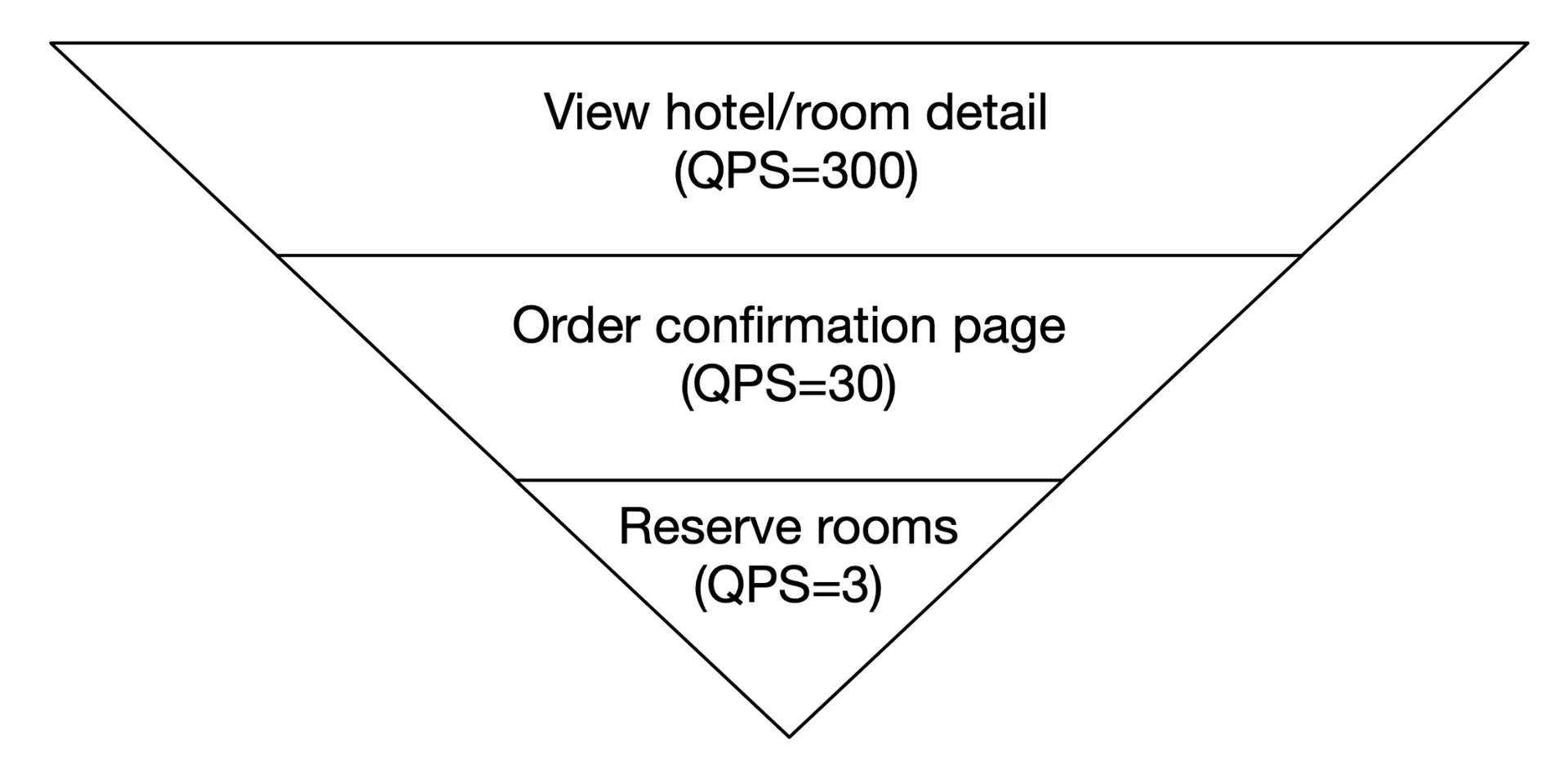
Figure 1. QPS distribution: detail page 300 QPS → booking page 30 QPS → reservation 3 TPS
Step 2 of 4: Propose high-level design and get buy-in
Goal: agree on the API, data model, and microservice split.
API design
Hotel-related APIs:
| API | Detail |
|---|---|
| GET /v1/hotels/ID | Get hotel details |
| POST /v1/hotels | Add hotel (staff only) |
| PUT /v1/hotels/ID | Update hotel (staff only) |
| DELETE /v1/hotels/ID | Delete hotel (staff only) |
Room-related APIs:
| API | Detail |
|---|---|
| GET /v1/hotels/ID/rooms/ID | Get room details |
| POST /v1/hotels/ID/rooms | Add room (staff only) |
| PUT /v1/hotels/ID/rooms/ID | Update room (staff only) |
| DELETE /v1/hotels/ID/rooms/ID | Delete room (staff only) |
Reservation-related APIs:
| API | Detail |
|---|---|
| GET /v1/reservations | Get reservation history |
| GET /v1/reservations/ID | Get reservation details |
| POST /v1/reservations | Make new reservation |
| DELETE /v1/reservations/ID | Cancel reservation |
POST /v1/reservations request body:
{
  "startDate": "2021-04-28",
  "endDate": "2021-04-30",
  "hotelID": "245",
  "roomID": "U12354673389",
  "reservationID": "U12354673390"
}
reservationID serves as the idempotency key to prevent double booking.
Data model
Access patterns:
- View hotel details
- Find available room types by date range
- Record a reservation
- Look up reservation / history
Why relational database:
- Read-heavy, write-light workflow (visitors >> bookers): NoSQL is optimized for writes, RDBMS works well for reads
- ACID guarantees (prevent negative balance, double charge, double reservations)
- Stable, clear relationships between entities (hotel, room, room_type)
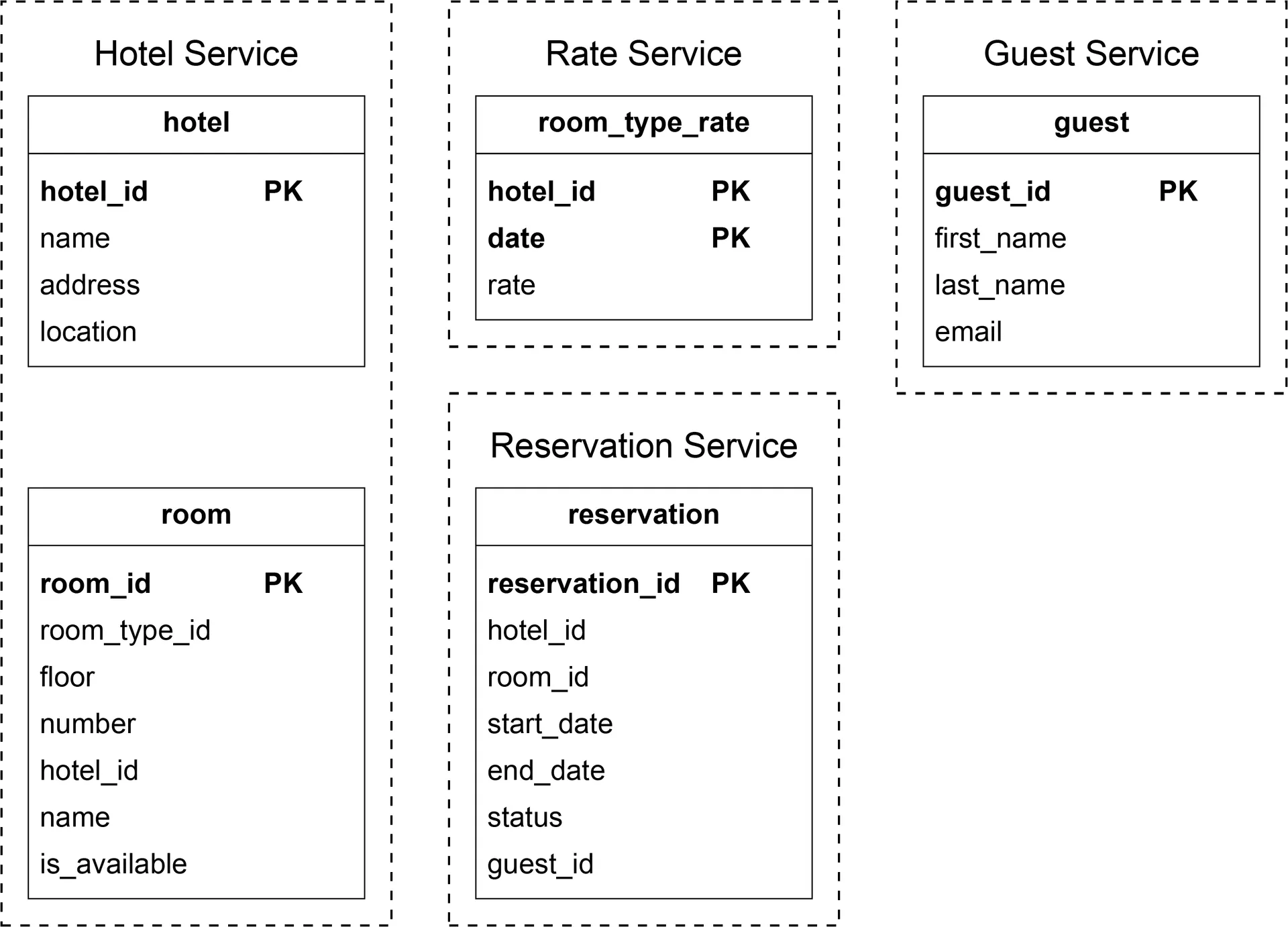
Figure 2: Database schema
Reservation status state machine (pending → paid/refunded/canceled/rejected):
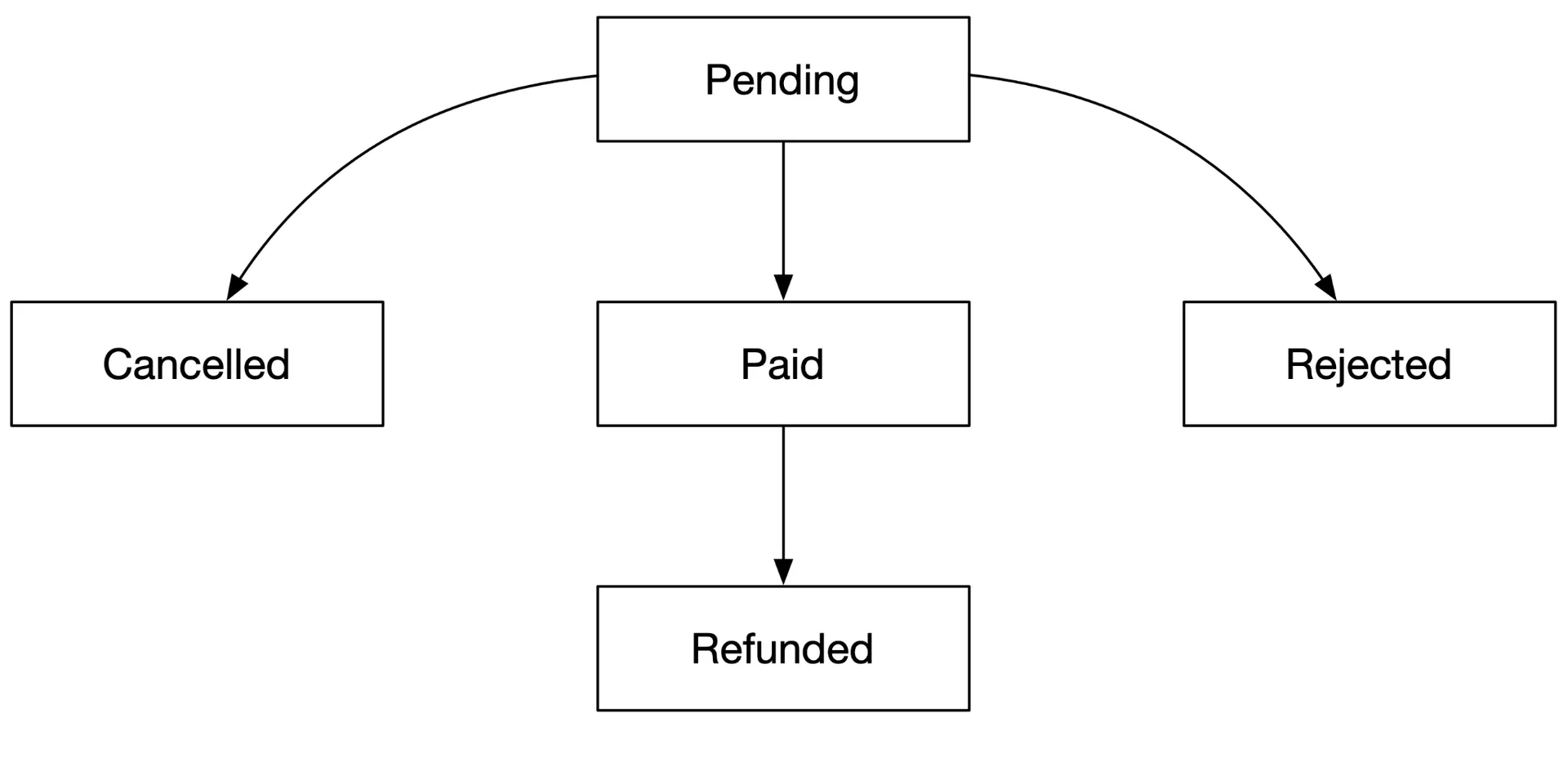
Figure 3: Reservation status
Key issue with the initial schema: users reserve a type of room (standard, king, queen), not a specific room. Room numbers are assigned at check-in. Requires an improved data model (see Deep Dive).
High-level design
Microservice architecture:
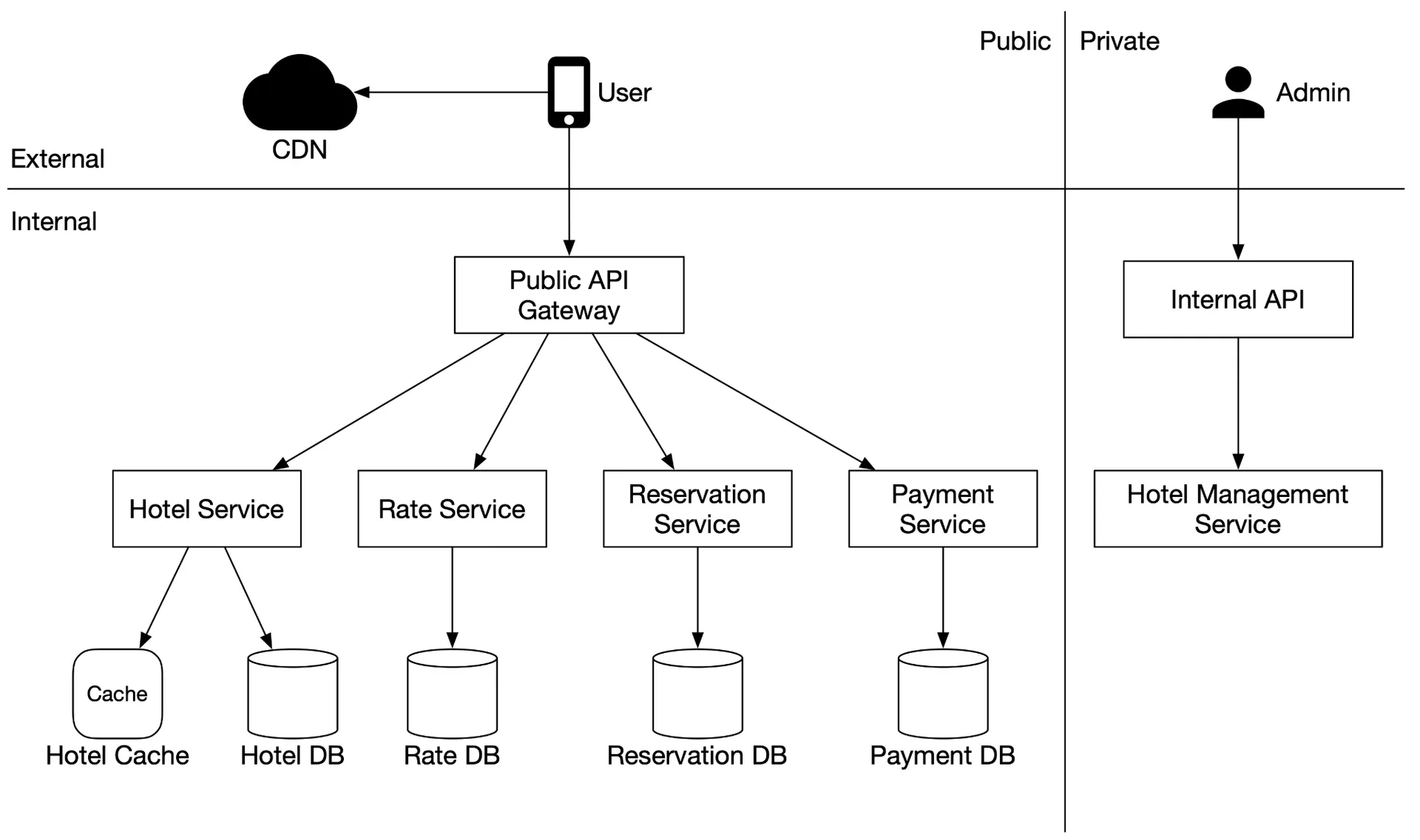
Figure 4: High-level design
Components:
- CDN: caches static assets (JS, images, videos, HTML)
- Public API Gateway: rate limiting, authentication, routes requests to services
- Internal APIs: hotel staff only, protected by VPN
- Hotel Service: hotel/room info (static, easily cached)
- Rate Service: room rates for future dates (price depends on expected occupancy)
- Reservation Service: receives reservation requests, tracks room inventory
- Payment Service: executes payment, updates reservation status
- Hotel Management Service: staff-facing admin operations
Services communicate internally (e.g. Reservation Service queries Rate Service for room rates). Inter-service comm uses gRPC.
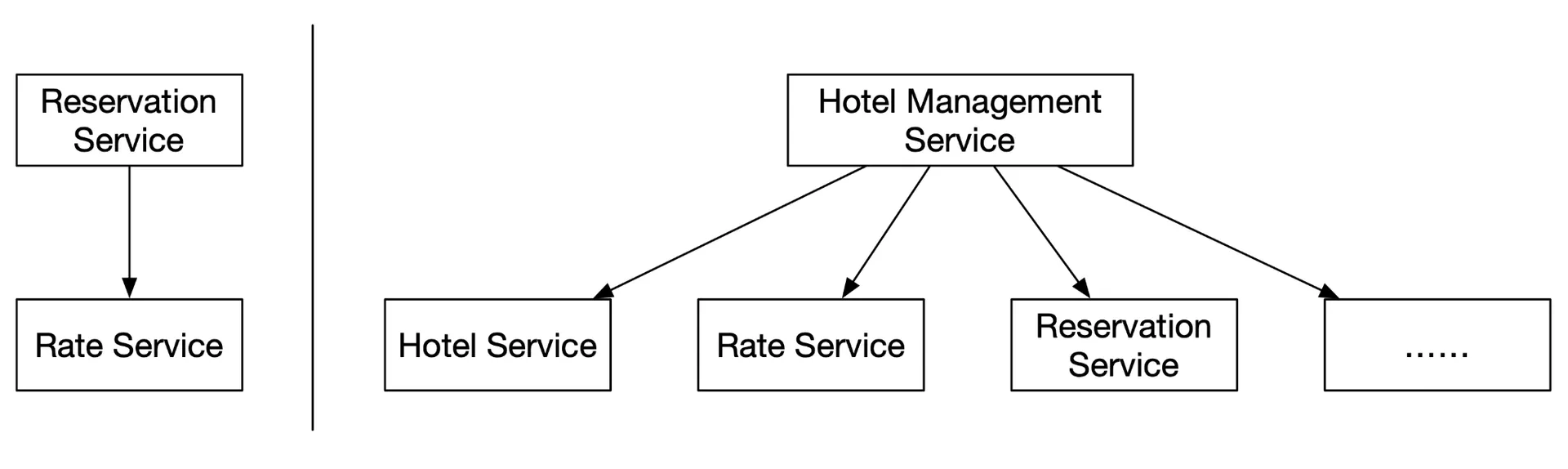
Figure 5: Connections between services
Step 3 of 4: Design deep dive
Goal: improved data model, concurrency, scaling, cross-service consistency.
Improved data model
Reservation API changes: roomID → roomTypeID + roomCount:
{
  "startDate": "2021-04-28",
  "endDate": "2021-04-30",
  "hotelID": "245",
  "roomTypeID": "12354673389",
  "roomCount": "3",
  "reservationID": "U12354673390"
}
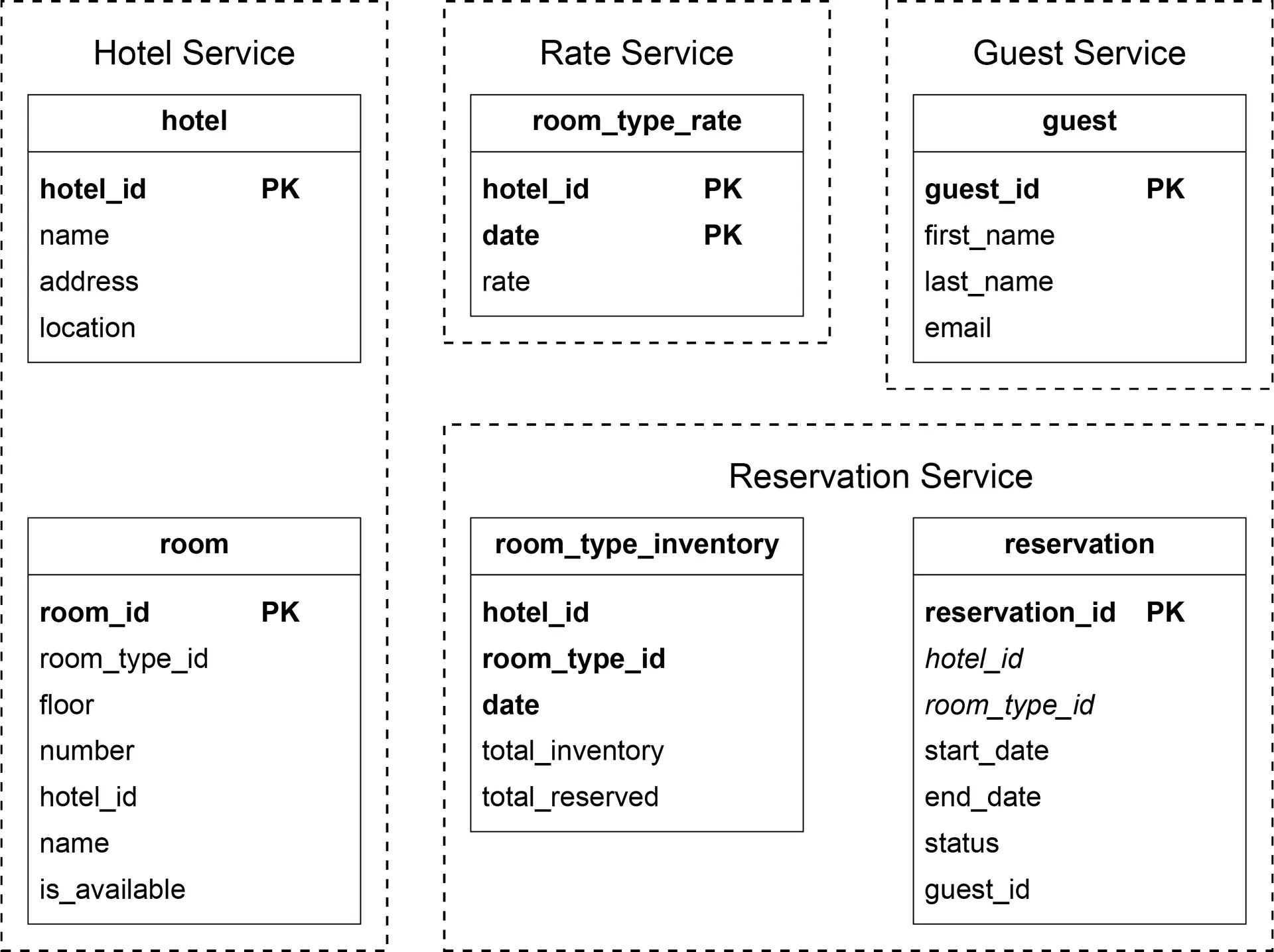
Figure 6: Updated schema
Key tables:
- room: room information
- room_type_rate: price data per room type for future dates
- reservation: guest reservation data
- room_type_inventory: inventory per hotel/room_type/date. Columns:
hotel_id,room_type_id,date,total_inventory,total_reserved. Composite PK:(hotel_id, room_type_id, date). Pre-populated for 2 years via a daily scheduled job
Storage estimation: 5,000 hotels × 20 room types × 2 years × 365 days = 73M rows: fits in a single database. Achieve HA via replication across regions/AZs.
| hotel_id | room_type_id | date | total_inventory | total_reserved |
|---|---|---|---|---|
| 211 | 1001 | 2021-06-01 | 100 | 80 |
| 211 | 1001 | 2021-06-02 | 100 | 82 |
| 211 | 1001 | 2021-06-03 | 100 | 86 |
| ... | ... | ... | ... | ... |
| 211 | 1001 | 2023-05-31 | 100 | 0 |
Table 4: Sample room_type_inventory data
Inventory check SQL:
SELECT date, total_inventory, total_reserved
FROM room_type_inventory
WHERE room_type_id = ${roomTypeId} AND hotel_id = ${hotelId}
AND date BETWEEN ${startDate} AND ${endDate}
Application checks: if (total_reserved + ${numberOfRoomsToReserve}) <= total_inventory
10% overbooking: if (total_reserved + ${numberOfRoomsToReserve}) <= 110% * total_inventory
Scaling beyond a single DB:
- Archive old reservation history (current + future only; past → cold storage)
- Shard by
hash(hotel_id) % number_of_servers
Concurrency issues
Two problems: (1) the same user clicks "book" multiple times, (2) multiple users book the same room simultaneously.
Problem 1: Idempotency key:
- Client-side: gray out/hide the "submit" button (unreliable)
- API:
reservation_idas idempotency key; a unique constraint on the primary key prevents duplicates
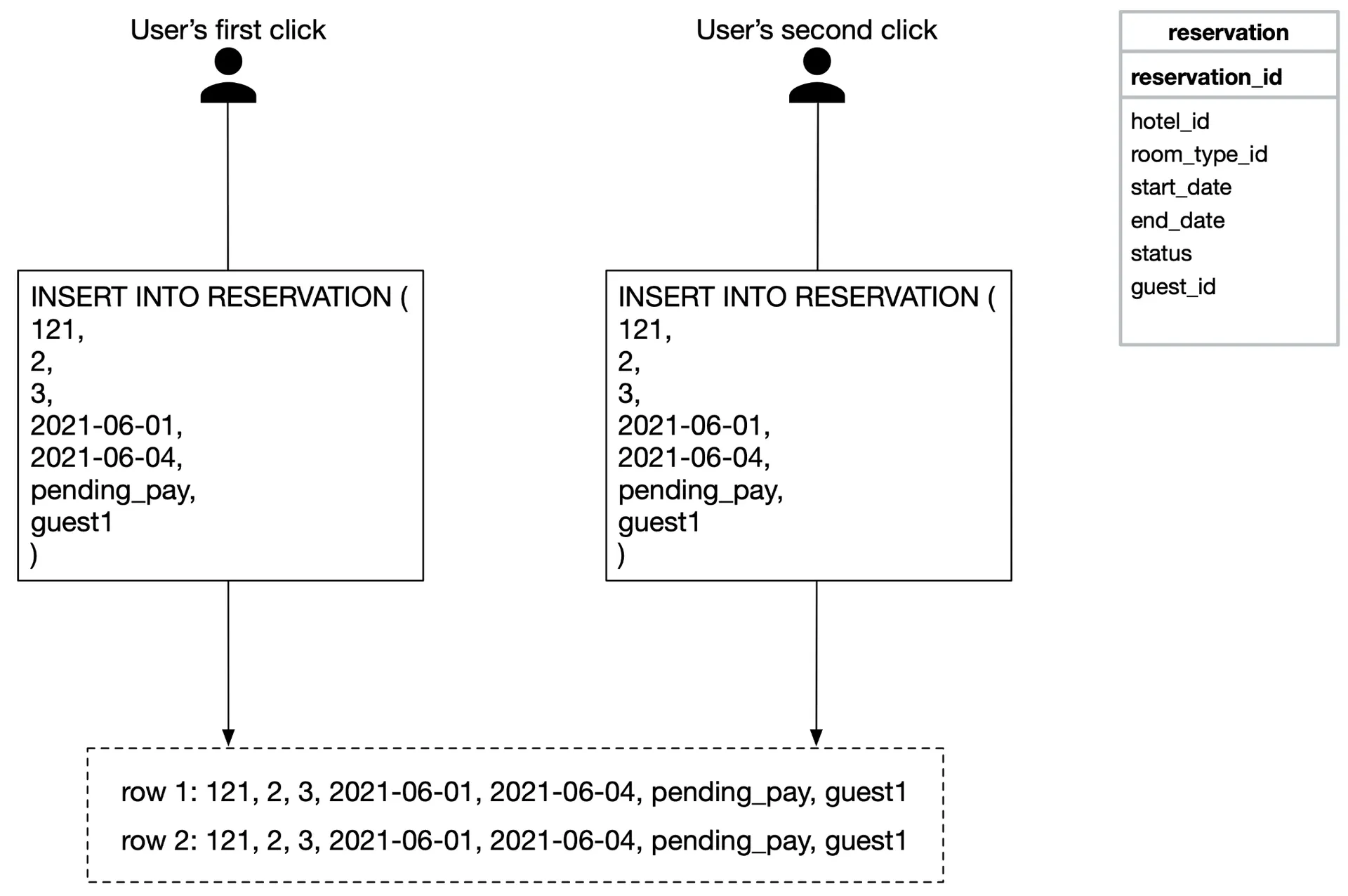
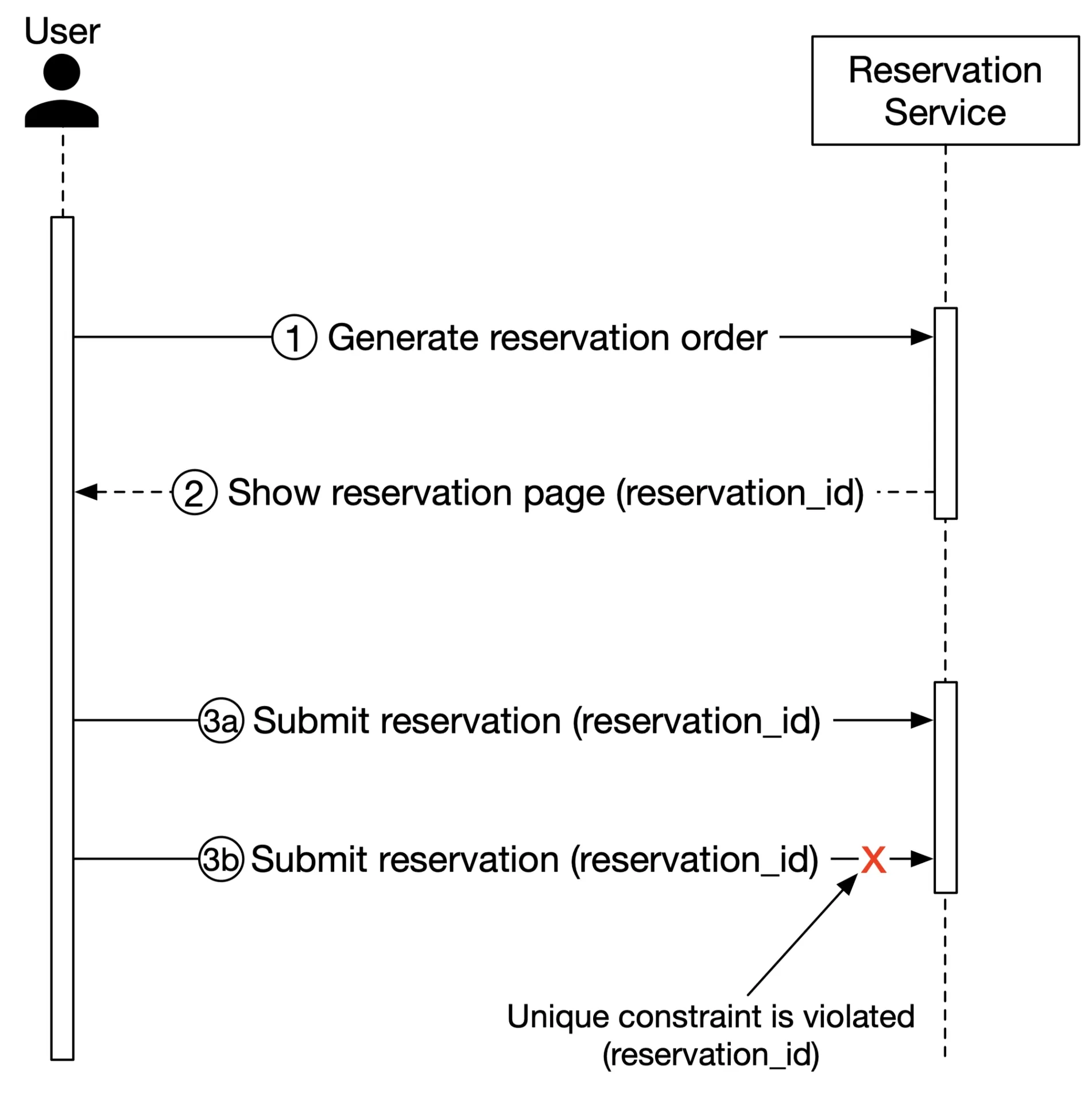
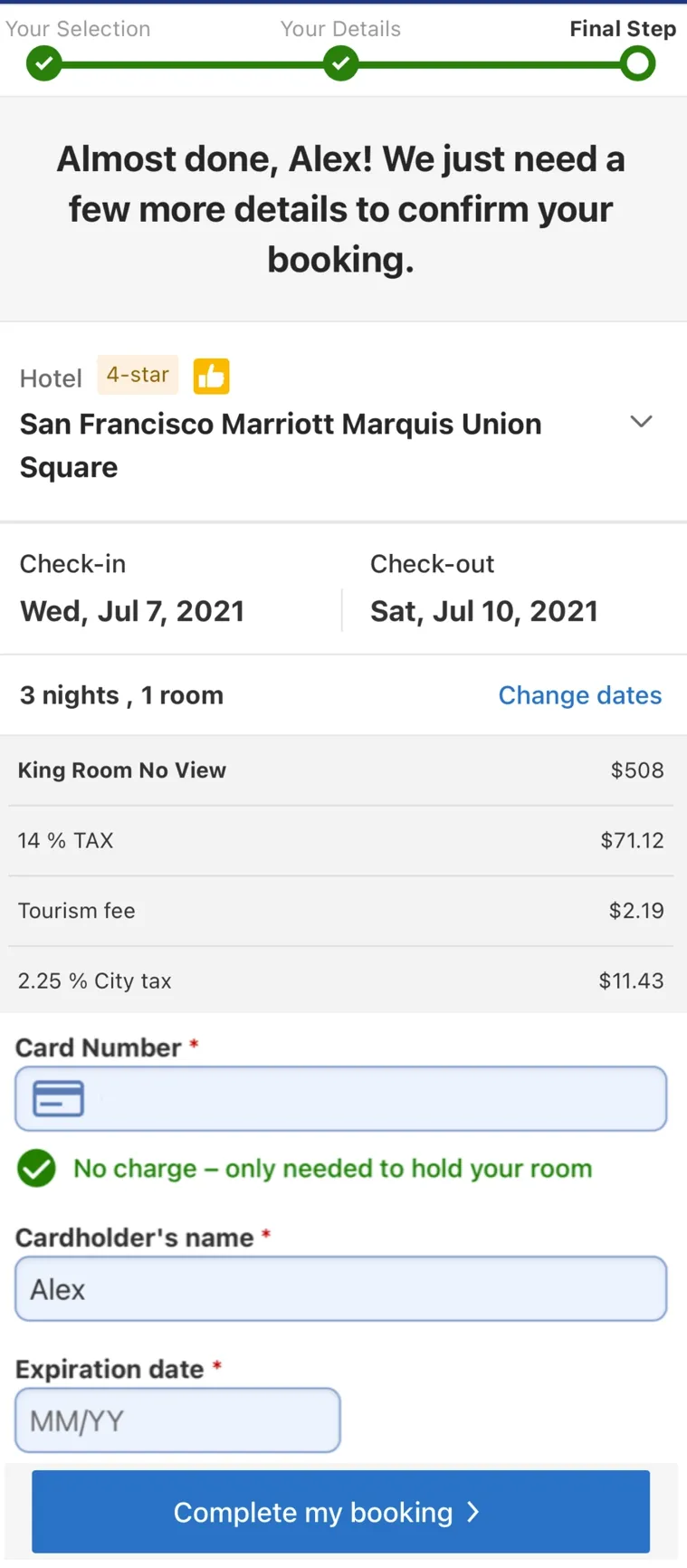
Figures 7-9: Double reservation, unique constraint, confirmation page
Workflow:
- Customer enters details → reservation service generates
reservation_id(globally unique) - System displays a confirmation page with
reservation_id - Submit:
reservation_idis the PK → second submit violates the unique constraint → rejected
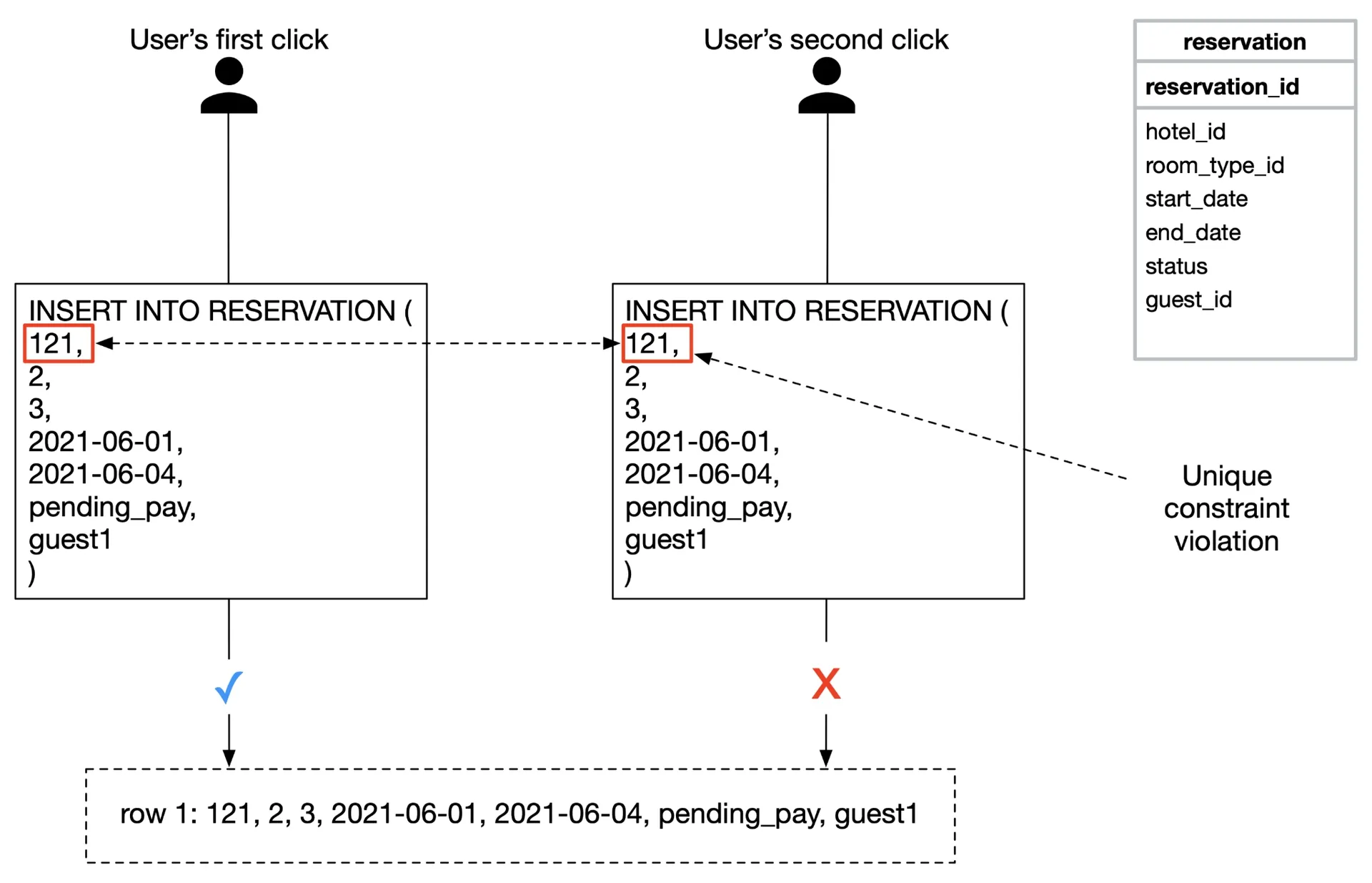
Figure 10: Unique constraint violation
Problem 2: Race condition (multiple users, last room):
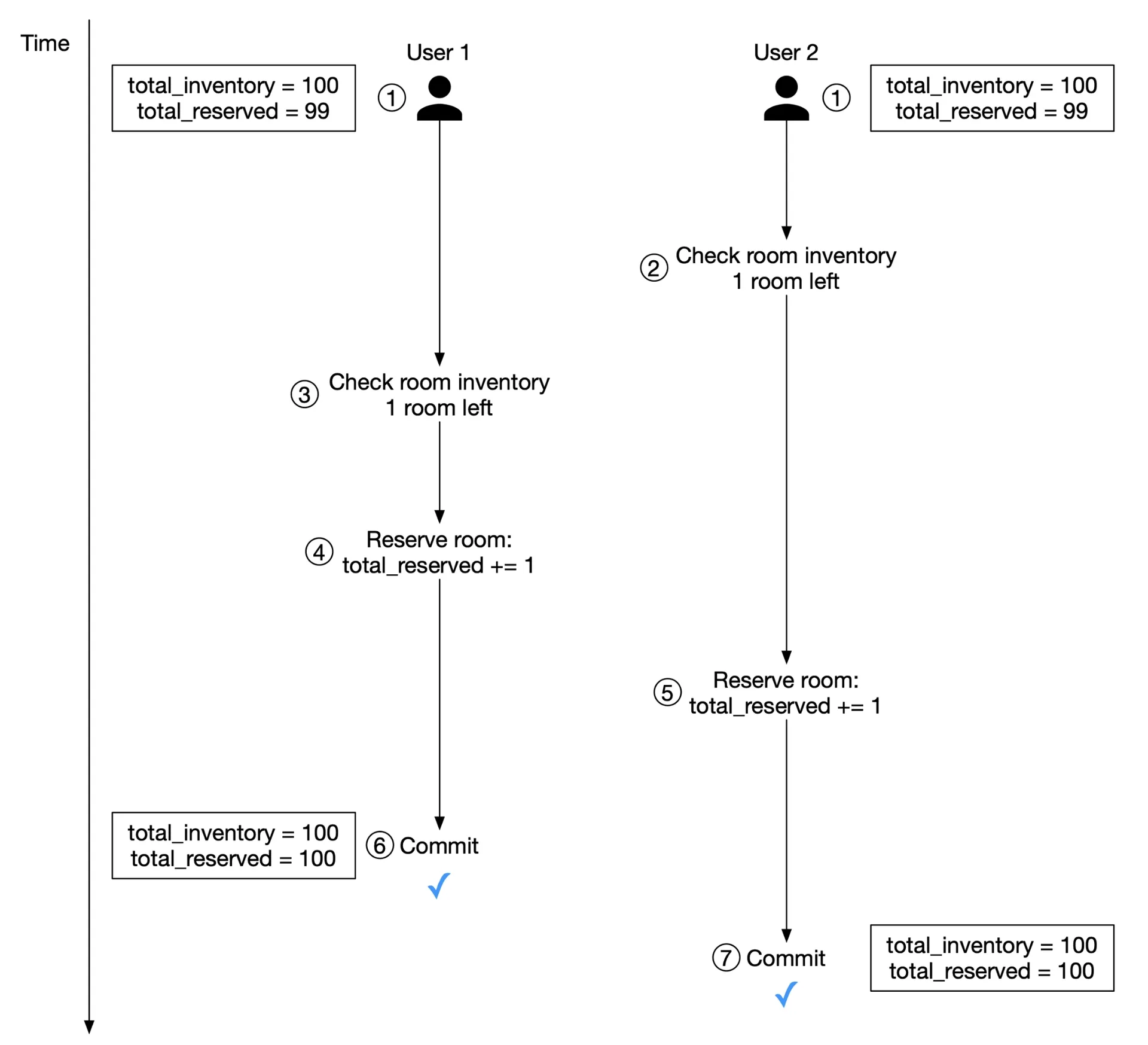
Figure 11: Race condition
Without serializable isolation: both transactions see 99 reserved (1 left), both book → double booking.
Three locking approaches:
Option 1: Pessimistic locking
SELECT ... FOR UPDATE locks rows. Other transactions wait.
- Pros: easy, prevents conflicts, good for heavy contention
- Cons: deadlocks possible, not scalable (long locks block others)
- Verdict: NOT recommended
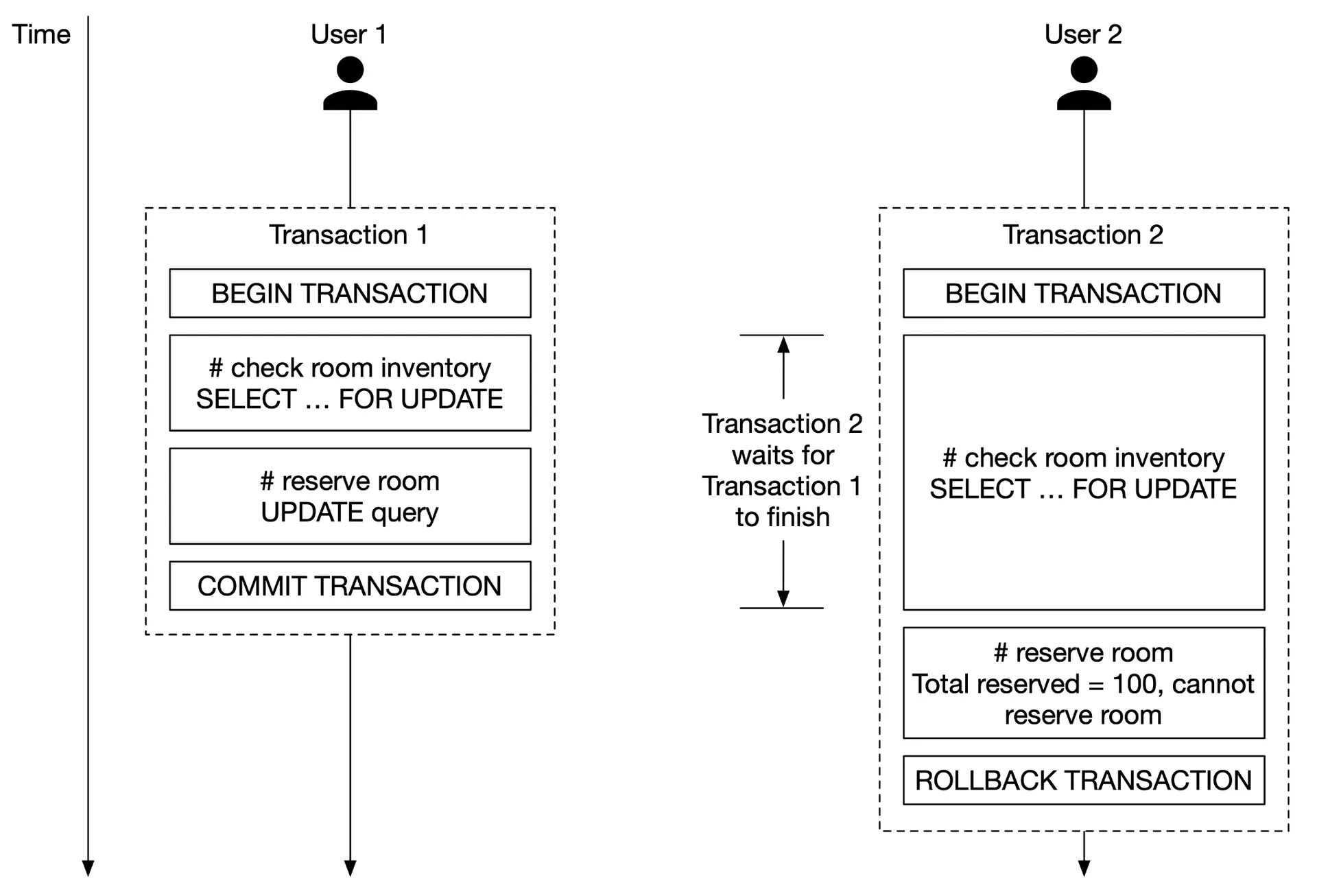
Figure 12: Pessimistic locking
Option 2: Optimistic locking
Version number column. Read version → update increments version by 1. DB validates next_version = current_version + 1.
- Pros: no DB locks, fast when contention is low
- Cons: poor performance under heavy contention (many retries)
- Verdict: good option for a hotel system (low reservation QPS)
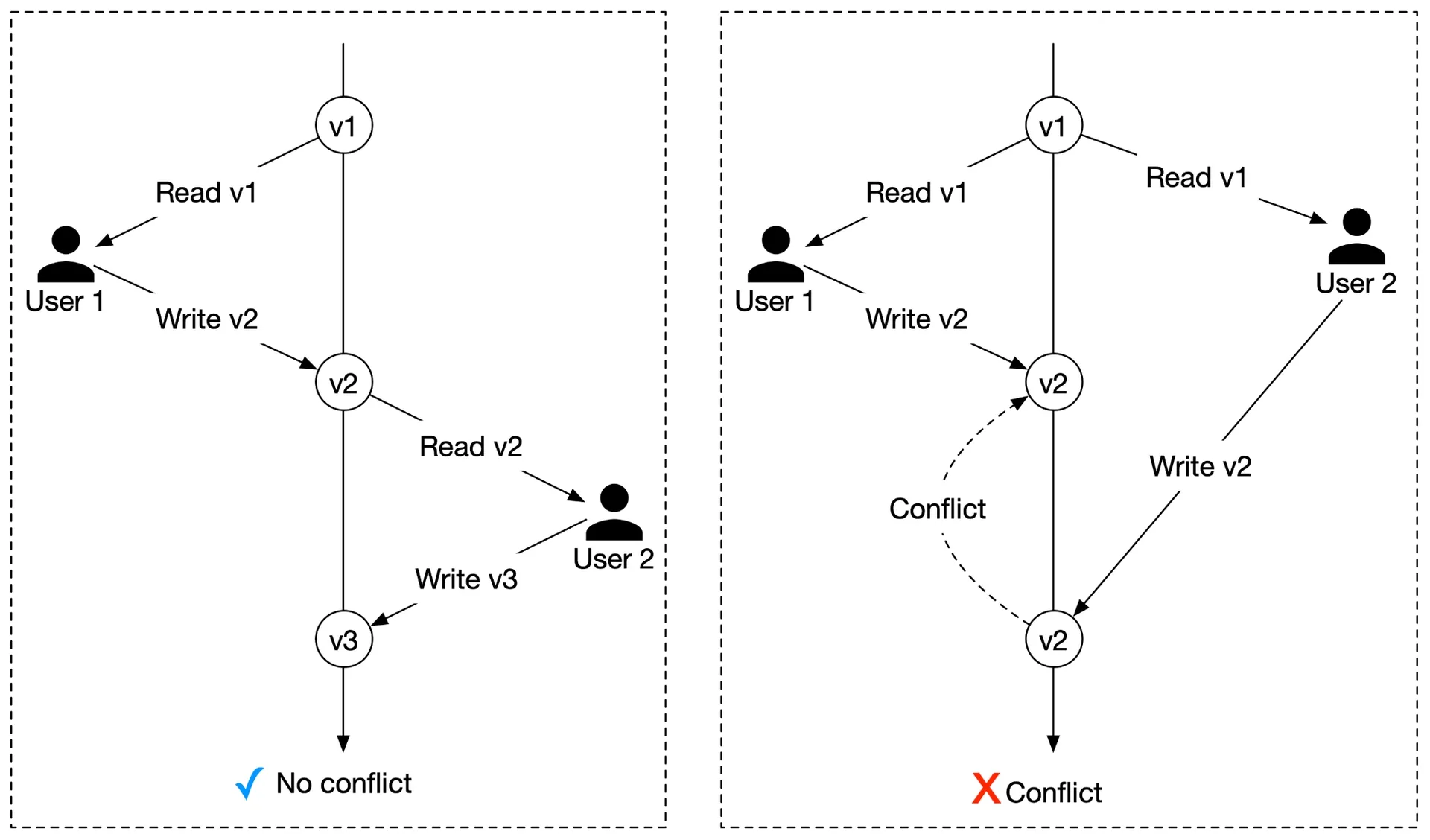
Figure 13: Optimistic locking
Option 3: Database constraints
CONSTRAINT `check_room_count` CHECK((`total_inventory - total_reserved` >= 0))
- Pros: easy to implement, good for low contention
- Cons: high failure rate under heavy contention; not version-controlled; not all DBs support
- Verdict: good option for a low-QPS hotel system
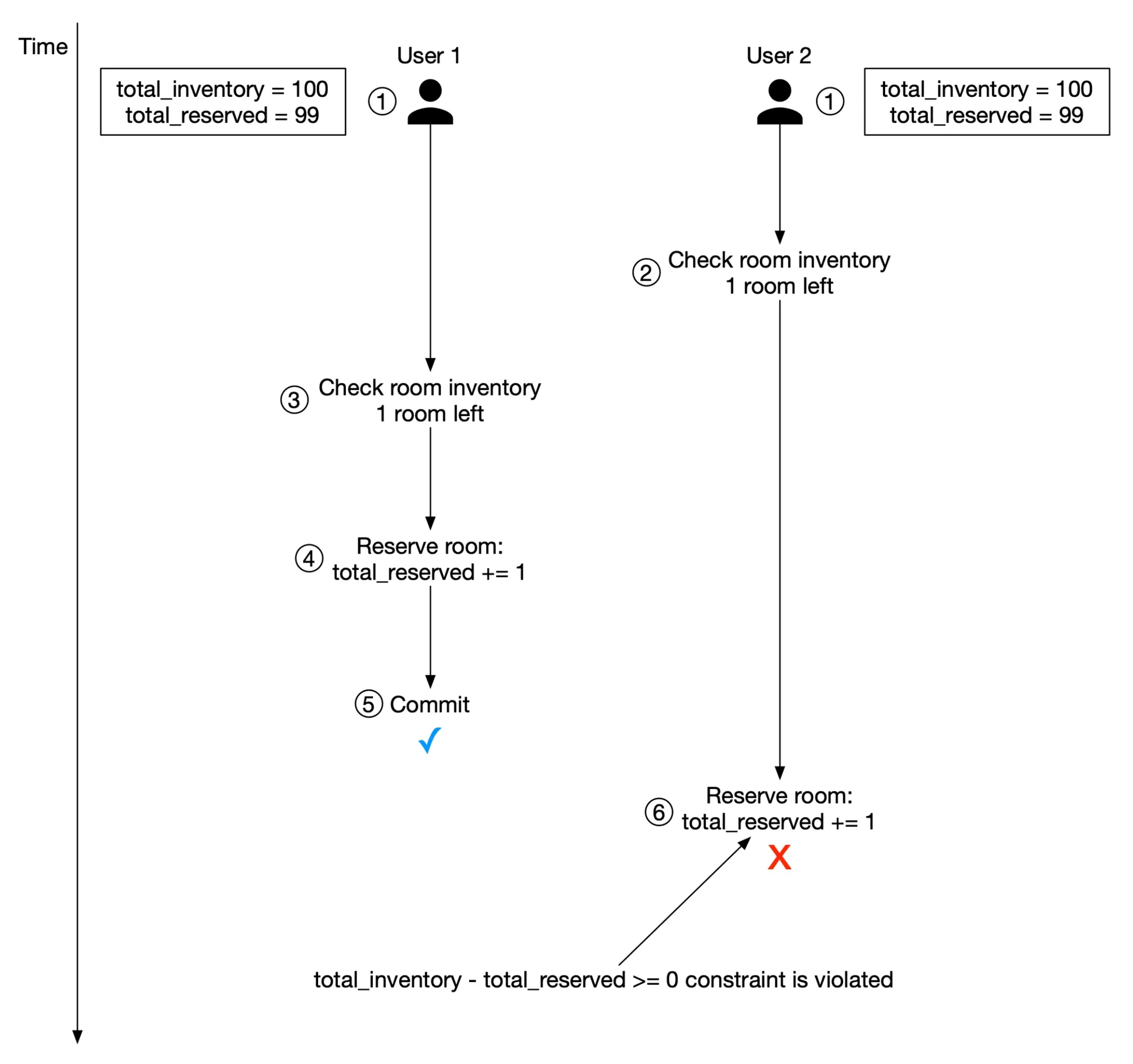
Figure 14: Database constraint
Reservation SQL pseudo-code:
-- Step 1: check inventory
SELECT date, total_inventory, total_reserved
FROM room_type_inventory
WHERE room_type_id = ${roomTypeId} AND hotel_id = ${hotelId}
AND date BETWEEN ${startDate} AND ${endDate};

-- For every row returned:
if ((total_reserved + ${numberOfRoomsToReserve}) > 110% * total_inventory) { Rollback }

-- Step 2: reserve rooms
UPDATE room_type_inventory
SET total_reserved = total_reserved + ${numberOfRoomsToReserve}
WHERE room_type_id = ${roomTypeId}
AND date BETWEEN ${startDate} AND ${endDate};
COMMIT;
Scalability
For booking.com/expedia scale (QPS 1,000× higher):
Database sharding: shard by hotel_id. 16 shards × 30,000 QPS → ~1,875 QPS per shard.
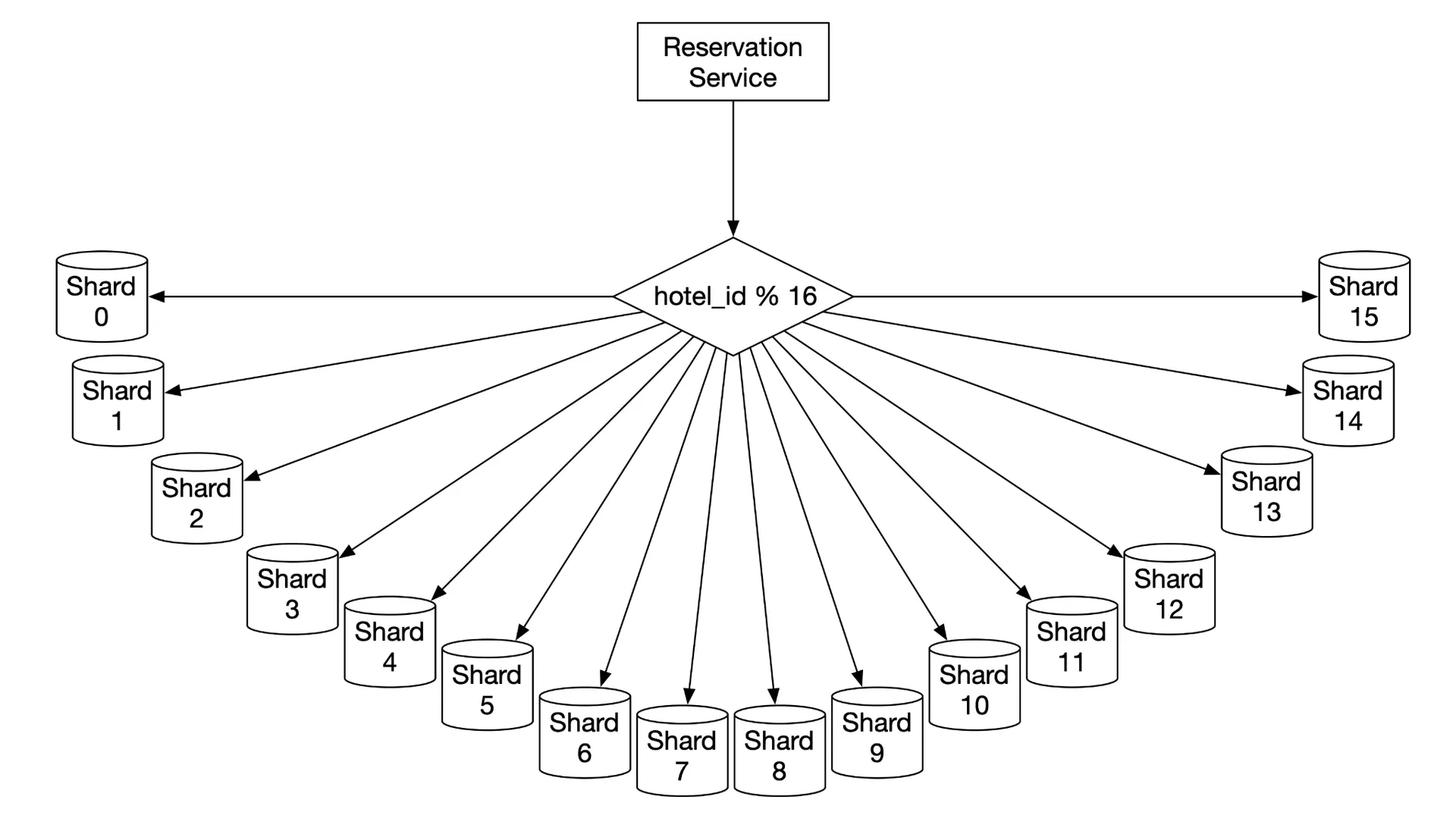
Figure 15: Database sharding
Caching (Redis):
- Only current + future inventory matters → TTL/LRU eviction
- Pre-populate inventory in Redis:
key: hotelID_roomTypeID_{date},value: available rooms - Read path: check Redis first → if available, validate against the DB (source of truth)
- Write path: update DB first → propagate to cache asynchronously (CDC/Debezium or app code)
- Cache-DB inconsistency is acceptable: DB does final validation. If cache says available but DB says full → error returned, cache syncs on next refresh
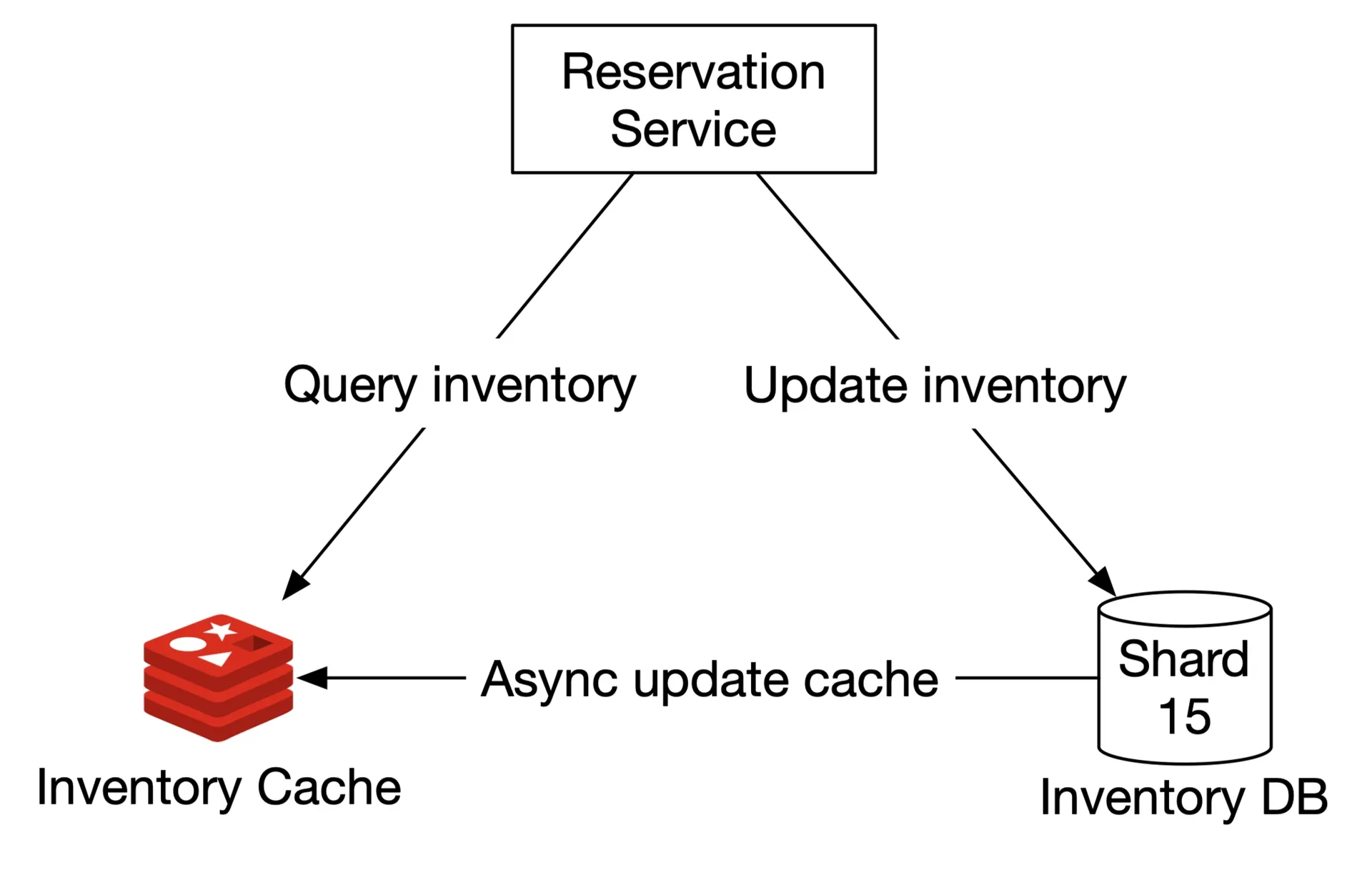
Figure 16: Caching
Data consistency among services
Hybrid approach: the Reservation Service owns both reservation and inventory tables in the same relational database → leverage ACID. If a microservice purist insists on separate DBs:
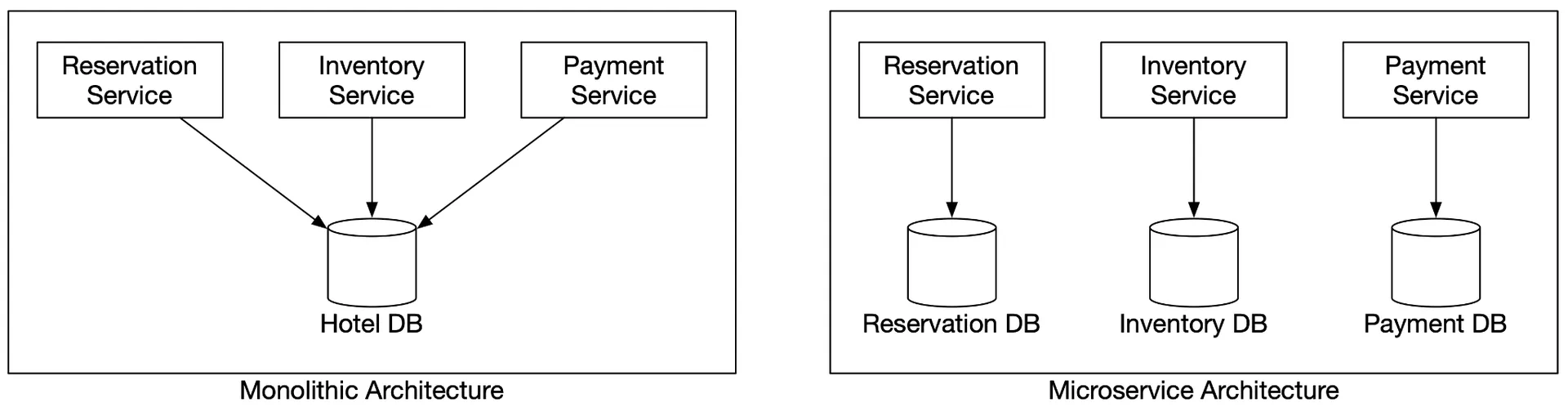
Figure 17: Monolithic vs microservice
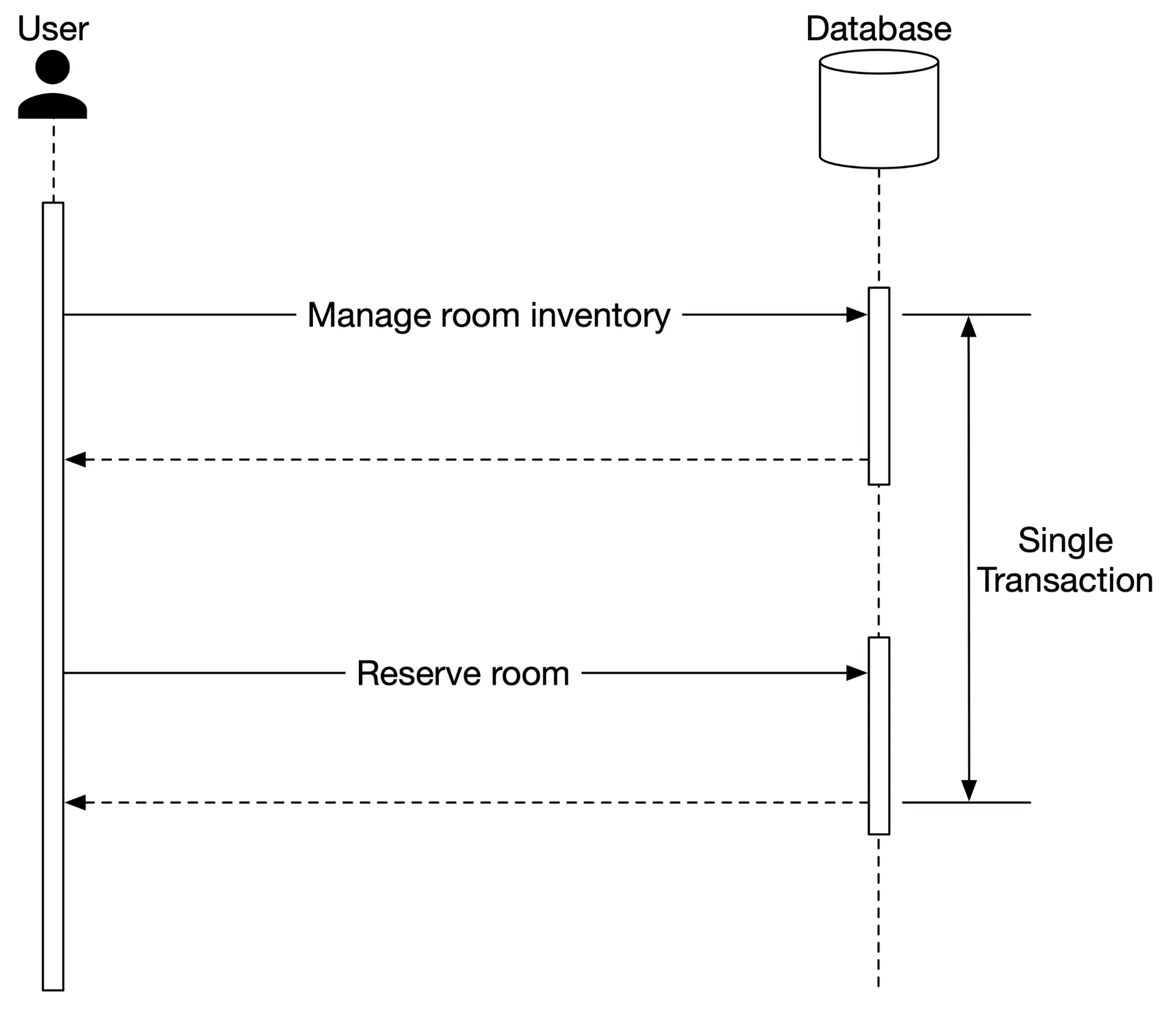
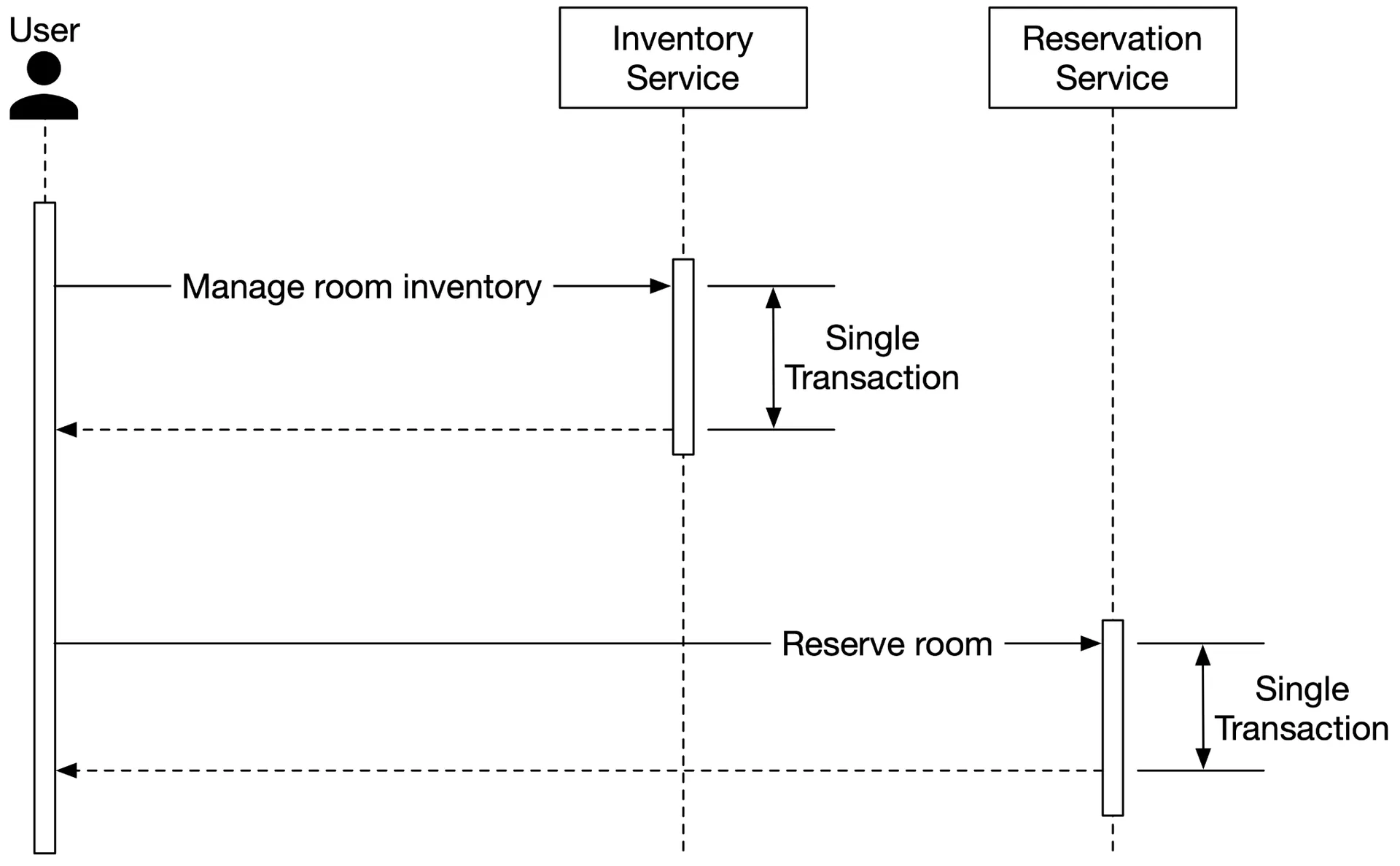
Figures 18-19: Monolithic vs microservice architecture
Solutions for cross-service consistency:
- 2PC (Two-phase commit): blocking protocol, atomic across nodes. A single node failure blocks progress. Not performant
- Saga: sequence of local transactions. Each step publishes a message for the next. On failure, compensating transactions undo preceding steps. Eventual consistency
Pragmatic choice: store reservation + inventory in the same DB: the complexity of distributed transactions is not worth it here.
Step 4 of 4: Wrap up
What we designed:
- Requirements → estimation → API/data model → architecture
- Room-type-level reservations (not specific rooms)
- Race condition solutions: pessimistic/optimistic locking, DB constraints
- Scaling via sharding + Redis cache
- Microservice data consistency (2PC, Saga)
Key design decisions: relational DB for ACID; hybrid service boundaries for pragmatic consistency.